Subtraction
Why no added sugar
A 20 oz sports drink can carry more added sugar than the American Heart Association's entire daily recommended limit for women. That sugar has one job: taste. The only carbohydrate in our formula is the small dextrose dose that opens the absorption pathway. Those are different things, and conflating them is how the sports-drink category ended up where it is.
Added sugar has two jobs, and neither is hydration
Sugar makes things taste good, and it provides calories. Those are its functions in a sports drink, just as they are in a soda. There is no third job.
The palatability function is real: people drink more of something that tastes better, which may improve total fluid intake. That is a legitimate argument. It is also a product design choice, not a physiological necessity — the underlying hydration mechanism does not require sweetness.
The calorie function matters in specific contexts. Endurance athletes burning through glycogen at race pace genuinely need carbohydrate fuel. A drink that doubles as a fuel source makes sense for a three-hour effort. It makes less sense for an hour of moderate exercise, for daily hydration, or for anyone watching their carbohydrate intake. Most sports drinks are not formulated around that distinction. They are formulated for the shelf.
What the category almost never separates is sweetening load from the small functional carbohydrate that actually assists absorption. Those are two different things at two different magnitudes, and only one of them belongs in the glass by default.
~34 g
added sugar a single 20 oz full-sugar sports drink can carry, per its Nutrition Facts panel
25 g
American Heart Association daily added-sugar limit for women — one bottle can clear it on its own
36 g
AHA daily added-sugar limit for men — roughly one bottle's worth in a sitting
Sweetener and color travel together
Flavor and color are rarely independent decisions in a sports drink. A product built around a fruit flavor is almost certain to carry the synthetic dye that reinforces the visual signal of that flavor.
Read across the labels and the pattern is hard to miss: the heavily flavored, brightly colored products tend to carry the heaviest sweetening loads, while unflavored or lightly flavored ones carry less. The logic is circular — a heavy sweetening load signals a flavor profile, the flavor profile implies a color, and the color implies a dye. Each ingredient justifies the next.
We carry neither. No added sweetener means no flavor system means no dye. The absence of one is part of what produces the absence of the others. The formula is not simply a conventional sports drink with things removed; it is a different object with a different starting premise: start from what absorption needs, add nothing else.
The result is a product that has no color to see and no sweetness to taste — which is either a feature or a problem depending on what you want from the glass. If the answer is hydration, it is a feature.
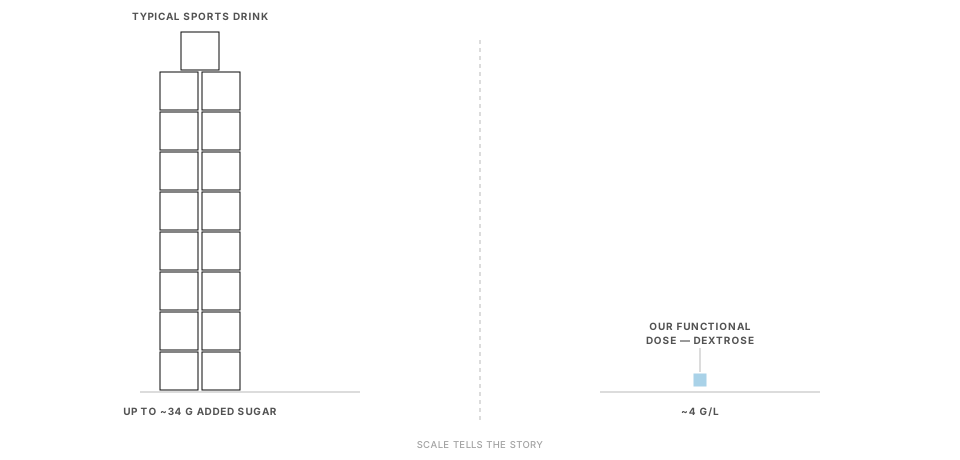
The only carb is the one that does something
Quick Rehydrate carries roughly 4 grams of dextrose per litre. That is not a sweetening dose. It is the amount the SGLT1 transporter needs to be occupied and running.
The sodium-glucose cotransporter SGLT1 sits in the lining of the small intestine and moves sodium ions and glucose molecules across the wall in tandem — two sodium per glucose. Water follows the sodium by osmosis. The mechanism is described in full in the sodium-glucose cotransport article, and the reason we use dextrose specifically rather than sucrose or another sugar is in why dextrose, not sugar. The short version: SGLT1 works on glucose directly; dextrose is glucose.
The dose is calibrated to the floor the mechanism needs. SGLT1 saturates — there is a finite amount of transporter, and once enough glucose is present to run it, additional glucose does not accelerate absorption. Past that saturation point, sugar is simply sugar in the bloodstream, raising osmolarity and doing nothing for uptake. The World Health Organization learned this and explicitly lowered the glucose in its oral rehydration formula in 2002 because the reduced-osmolarity version outperformed the older, more concentrated one.
At 4 g/L, the dextrose in Quick Rehydrate is at or near the functional floor. It is below the threshold of perceptible sweetness in most people. It is not a sweetener. It is a mechanism activator, and the distinction matters.
The all-day Normal formula carries no dextrose at all. Sipped slowly across the day, it does not need accelerated uptake — the passive absorption mechanisms are sufficient at that pace, and the sodium dose is calibrated accordingly.
Every gram of carbohydrate in our formula is functional. If it does not assist absorption, it is not in the glass.
Hydration without a sugar load
~2.4 g
dextrose per 20 fl oz bottle of Quick Rehydrate — the functional dose
0 g
added sugar in Normal formula — none needed at a slow hydration pace
0 g
sweeteners of any kind — sugar, high-fructose corn syrup, sugar alcohols, or otherwise
The practical result: you can use Quick Rehydrate after an effort without layering a sugar spike on top of it. You can use Normal across the whole day without a daily added-sugar accumulation that competes with what you eat. Neither drink has a taste profile that requires flavor reinforcement or a color that needs a dye.
That is the point of starting from the mechanism rather than from the shelf. The formula is not constrained by what tastes good at focus group. It is constrained by what the absorption physiology needs — and the absorption physiology does not need a teaspoon of added sugar to work.
This statement has not been evaluated by the Food and Drug Administration. This product is not intended to diagnose, treat, cure, or prevent any disease.
Sources
- American Heart Association. Added sugars guidance — about 25 g/day (6 tsp) for most women, about 36 g/day (9 tsp) for most men, and about 25 g/day for children. heart.org.
- Per-serving sugar figures for full-sugar sports drinks drawn from manufacturer Nutrition Facts panels (e.g., Gatorade Thirst Quencher, Powerade) — roughly 34 g per 20 fl oz bottle, about 58 g/L.
- Buccigrossi V, Russo C, Marano A, et al. Potency of oral rehydration solution in inducing fluid absorption is related to glucose concentration. Scientific Reports 10:7803, 2020. doi:10.1038/s41598-020-64818-3 — the functional role of glucose in SGLT1-mediated absorption.
- World Health Organization / UNICEF. Reduced osmolarity oral rehydration salts (ORS) formulation, 2002 — lowered glucose and sodium, improved absorption outcomes vs. the prior higher-concentration formula.
Only what the mechanism needs
The label reads the way it does because the formula starts from physiology, not palatability. The science hub maps the rest of the picture.