Subtraction
Why no dyes
Synthetic color does exactly one job — make a product look more appealing. It contributes no electrolytes, no absorption benefit, nothing your body can use. The evidence trail connecting some dyes to neurobehavioral effects in children, a recent FDA revocation, and the pattern in sports drinks specifically: here is the case for leaving it out.
Appearance, and that is the entire list
Open any mainstream sports drink and the color hits before anything else. That color is not an accident and it is not a byproduct of the formula. It is an ingredient added deliberately, after the fact, to make the drink look like it is doing something.
Synthetic food dyes are petroleum-derived compounds approved for use in food and beverages. They appear under names like FD&C Blue No. 1, Red No. 40, Yellow No. 5, and Yellow No. 6. They do not affect flavor. They do not affect electrolyte content. They have no effect on how quickly water crosses your gut wall or how well sodium is absorbed. The job they perform is visual: signal citrus, berry, tropical, or nothing in particular — but something vivid.
That is not automatically a reason to avoid something — plenty of inert ingredients are harmless — but it does set the bar precisely. If something does nothing for you, the only question left is whether it does anything to you.
What a dye does for the drink
- Changes color to signal flavor or brand identity.
- Makes the product visually distinct on a shelf.
- Creates an impression of activity or potency.
What a dye does for your body
- Nothing for electrolyte content.
- Nothing for absorption rate or fluid movement.
- No nutritional contribution of any kind.
What the research says — and what it does not
The question is not whether dyes are toxic at any dose. It is whether the signal in the literature is real enough to matter when the ingredient contributes nothing on the other side of the ledger.
In 2021, California’s Office of Environmental Health Hazard Assessment (OEHHA) published a peer-reviewed technical report — the most rigorous government-commissioned assessment to date — reviewing the evidence connecting synthetic food dyes to neurobehavioral effects in children. The report concluded that synthetic food dyes can cause or exacerbate hyperactivity and other neurobehavioral effects in some children.
The key word is “some.” Sensitivity varies substantially by individual. The literature does not support reading this as “dyes harm all children” or “dyes cause ADHD.” What it supports is a narrower, more honest claim: for a subset of children, particularly those already showing behavioral sensitivities, synthetic dye consumption is associated with measurable changes in activity and attention. The OEHHA report, and a 2022 peer-reviewed review in Environmental Health, both make this point carefully.
The mechanism is not fully established. Neither is the dose-response. This is an area of genuine ongoing scientific discussion, not a closed question. What is clear is that the signal is real enough to have driven regulatory action.
The 2021 OEHHA assessment found effects in some children — not all. The science is an open question on mechanism and dose; the policy response has moved further and faster than the mechanism is settled.
How the rules changed, step by step
The policy response has moved in a single direction. The timeline is worth following closely, because the direction matters as much as any individual decision.
OEHHA assessment — 2021
California’s OEHHA publishes its technical report concluding that synthetic food dyes can cause or exacerbate neurobehavioral effects in some children. First major government-commissioned review to reach this conclusion in the U.S. It becomes the primary evidentiary basis for subsequent regulatory action.
FDA revokes Red No. 3 — January 2025
The U.S. Food and Drug Administration revokes its authorization for FD&C Red No. 3 in food and ingested drugs. The revocation rests on the Delaney Clause — a statutory provision that bars the FDA from authorizing any color additive found to induce cancer in humans or animals, with no dose threshold. The underlying finding was cancer in male rats exposed to high doses, through a mechanism the FDA states does not operate in humans; the agency notes the available evidence does not show that Red No. 3 at typical exposures puts people at risk. The Delaney standard does not require a human-risk finding to act. The revocation is best read as the prior authorization no longer being defensible under that standard, not as a verdict on human harm.
Reformulation deadlines
Manufacturers of food and dietary supplements must remove Red No. 3 by January 2027. Makers of ingested drugs have until January 2028. Red No. 3 was already falling out of common use before the revocation, but the deadline formalizes the exit.
California school restrictions
California restricts synthetic food dyes in school meals — the broadest direct-use restriction in the U.S. to date. Whether federal standards will converge with California’s approach is an open question, but the direction of travel in regulatory posture is clear.
79 %
of sports drinks contained at least one synthetic dye in a single 2025 survey of US packaged products (Dunford et al.)
141 %
more added sugar, on average, in dyed products than undyed ones in that same survey — a correlation, not a cause
2025
year the FDA revoked Red No. 3 authorization, effective 2027 for food and supplements
Both figures come from one study — Dunford and colleagues’ 2025 survey of synthetic dyes in US packaged foods and beverages, published in the Journal of the Academy of Nutrition and Dietetics — and reflect that surveyed sample (product data from 2020), not the full category over time. They are consistent with the visible pattern on the shelf, but they are not population-level statistics, and one survey is one survey. The correlation between synthetic color and higher added sugar is real in the data; the causal direction is not established. What the pattern points to is a formulation style: products that lean on color for appeal tend to lean on sweetness for the same reason. Both are aesthetic additions. Neither does physiological work.
Why the glass is clear
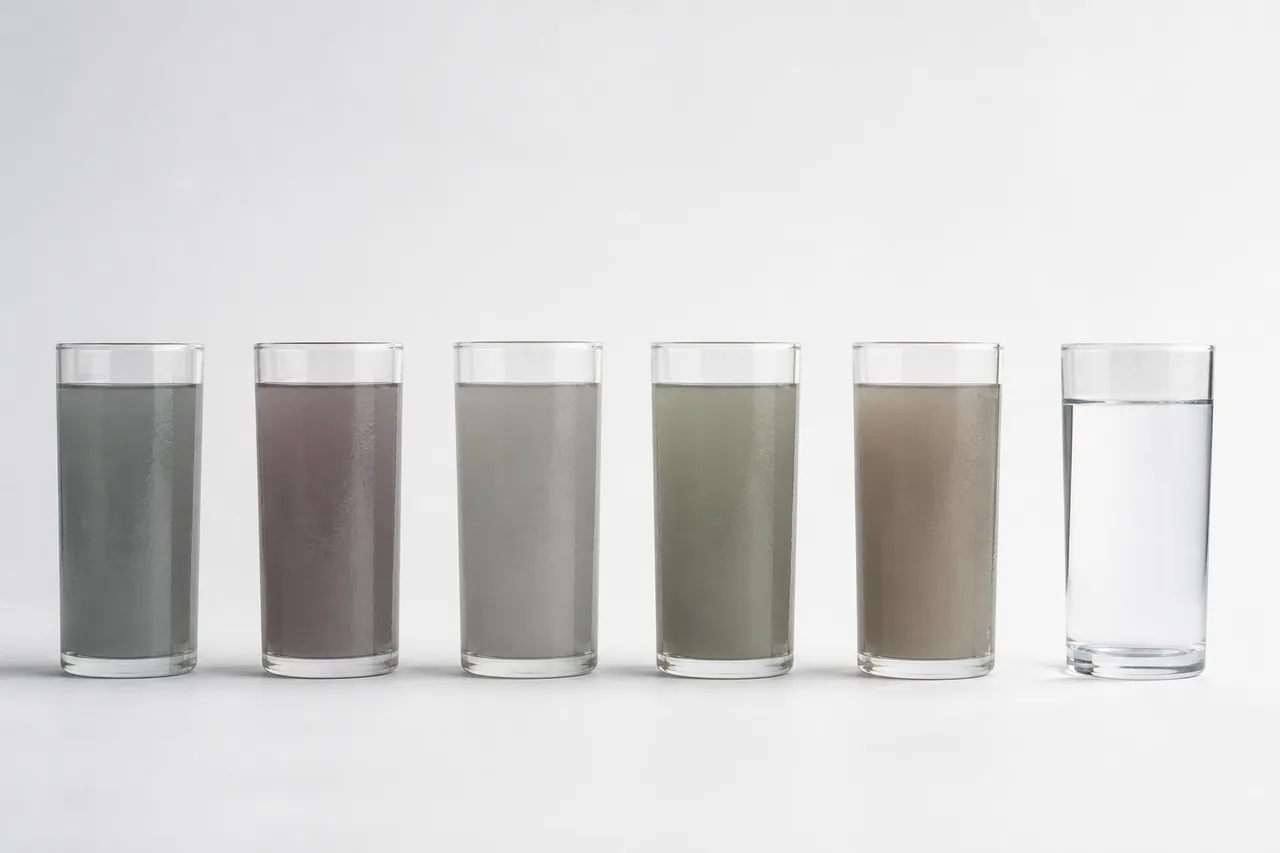
Nothing in our formula is there to make the drink look like something. There is no color because color was not on the list of things that needed to be there. The list starts with what the body needs to rehydrate — sodium, potassium, magnesium, calcium, and in Quick Rehydrate a functional dose of dextrose — and it ends there.
That is not a statement about aesthetics or minimalism. It is the same test applied to every other ingredient: what physiological job does this do? Sodium drives fluid retention and muscle signaling. Potassium works alongside it. Magnesium supports contraction and recovery. Dextrose turns the sodium-glucose cotransporter. A synthetic yellow or blue does not clear the bar.
The asymmetry makes the decision easy. Zero physiological benefit on one side; a genuine if variable evidence trail of concern on the other; and a regulatory posture that has been moving in one direction for several years. If you are someone for whom synthetic dyes turn out to be a non-issue — most adults in most contexts — you have lost nothing. If you are someone for whom they matter, the drink was already built without them. The clear glass is the honest one.
This statement has not been evaluated by the Food and Drug Administration. This product is not intended to diagnose, treat, cure, or prevent any disease.
Sources
- OEHHA (California EPA). Health Effects Assessment: Potential Neurobehavioral Effects of Synthetic Food Dyes in Children. April 2021.
- U.S. FDA. Revocation of authorization for FD&C Red No. 3 in food and ingested drugs (order January 2025; food and dietary-supplement uses end January 2027, ingested drugs January 2028). Federal Register, 90 FR 4628.
- Dunford EK, Galligan TM, Smith Taillie L, Musicus AA. All the Colors of the Rainbow: Synthetic Dyes in US Packaged Foods and Beverages in 2020. Journal of the Academy of Nutrition and Dietetics 2025;125(9):1207. (Source of the sports-drink and added-sugar figures cited above; analysis of 2020 product data.)
- Miller MD, Steinmaus C, Golub MS, et al. Potential impacts of synthetic food dyes on activity and attention in children: a review of the human and animal evidence. Environmental Health 2022;21:45.
The clear glass
Every ingredient in the formula is there because it earned its place. The science hub maps the rest of the picture.