Mechanism & formula
Why dextrose, not sugar
Dextrose is glucose. Glucose is what the SGLT1 transporter requires to pull sodium across the gut lining. The question is not whether to include it — the mechanism demands a small amount. The question is whether to include more than the mechanism requires. We do not.
Same molecule, different job
Dextrose is glucose — the same monosaccharide, the same six-carbon ring, the same molecule your cells run on. The name is a commercial and labeling convention, not a different substance.
- Dextrose
- Pure crystalline glucose, typically derived from corn starch. The specific molecule that the SGLT1 cotransporter binds and carries across the intestinal wall paired with sodium. No fructose fraction. No disaccharide bond to break first. Available to the transporter immediately.
- Sucrose (table sugar)
- A disaccharide of glucose and fructose, bonded together. Must be cleaved by the enzyme sucrase before the glucose fraction can act at SGLT1. The fructose half is absorbed separately via a different transporter — GLUT5 — and does not contribute to sodium-coupled uptake at all.
- High-fructose corn syrup
- A mixture of free glucose and free fructose, typically 42–55% fructose by mass. Some glucose is present, but a large fraction of the carbohydrate load is fructose and contributes nothing to cotransport. A poor choice for a formula whose only carbohydrate goal is running SGLT1.
The reason we say “dextrose” rather than “sugar” is not to obscure what is in the product. It is to be precise. “Sugar” conventionally refers to sucrose, or to a broad category of sweetening carbohydrates. “Dextrose” is the specific molecule the cotransport mechanism requires — available immediately, without enzymatic processing, with no fructose byproduct. The distinction matters because the job here has nothing to do with sweetness.
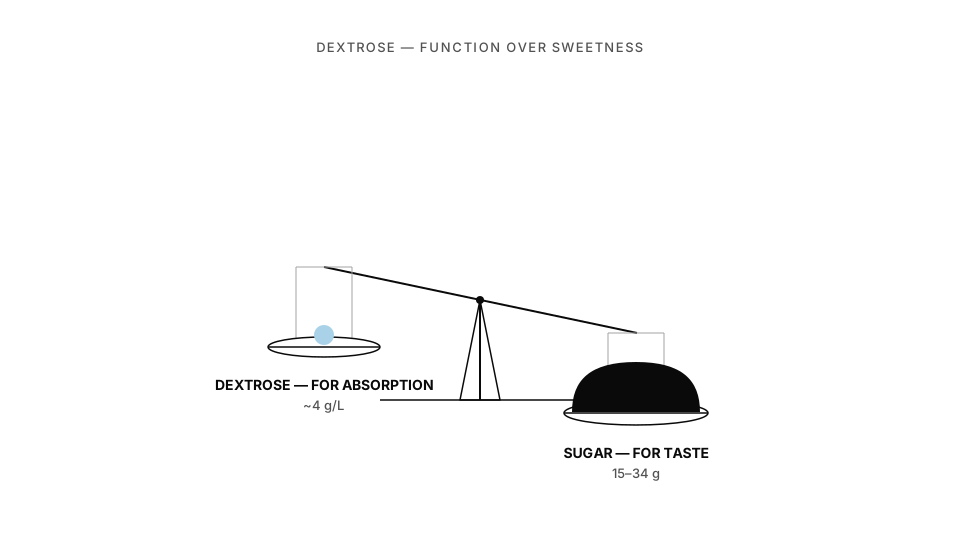
Functional dose vs. sweetening dose
The SGLT1 transporter saturates. Once enough glucose is present to run it near capacity, more glucose adds nothing to absorption. It adds osmolarity, calories, and sweetness — none of which are what this formula is for.
Sugar, for taste
- Roughly 14–36 g of sugar per serving in typical full-sugar sports drinks — about 58–62 g/L in the full-sugar versions of the leading brands.
- Present primarily for palatability — to encourage consumption by making the drink taste good.
- May serve as caloric fuel in endurance contexts where carbohydrate replacement matters.
- Raises osmolarity substantially; at high enough concentration, can draw fluid into the gut rather than out of it.
- Far exceeds the dose the SGLT1 transporter can use for cotransport. The surplus is metabolised as carbohydrate, not absorbed via the sodium pathway.
Dextrose, for absorption
- ~4 g/L dextrose in Quick Rehydrate (about 22 mmol/L) — enough to engage SGLT1.
- Present to run the cotransporter, not to sweeten the drink. Does not register as noticeably sweet at this concentration.
- No caloric fuel goal. No palatability goal. One job: engage the sodium-glucose pathway.
- Keeps osmolarity in a range where water tends to move across the gut lining toward absorption.
- The WHO reduced-osmolarity ORS (2002) uses glucose at 75 mmol/L (about 13.5 g/L) for acute clinical rehydration; we dose below that because our context is everyday hydration, not acute illness.
The SGLT1 transporter in the wall of the small intestine binds sodium and glucose together and carries them across the gut lining as a pair. Without glucose present, sodium uptake is substantially slower. With the right amount of glucose, the transporter operates near capacity and water follows sodium by osmosis. This is the mechanism behind oral rehydration therapy and the same mechanism described in detail in the sodium-glucose cotransport article.
Clinical oral rehydration solutions for acute illness carry far more glucose — the WHO reduced-osmolarity formula sits at 75 mmol/L, about 13.5 g/L. For everyday hydration, the goal is narrower: present enough glucose to engage the transporter without driving osmolarity up. Quick Rehydrate is dosed at about 4 g/L, roughly 22 mmol/L (4 g/L ÷ 180 g/mol). That is well above the transporter’s binding affinity, so the pathway is engaged, while the particle count stays low enough that water tends to move toward absorption rather than into the gut.
The principle, expressed in three numbers
~4 g/L
dextrose in Quick Rehydrate — the functional dose to run SGLT1
~2.4 g
glucose per 20 fl oz bottle — enough to open the pathway, not to taste sweet
0 g
dextrose in Normal — accelerated uptake is not the priority when you sip all day
Quick Rehydrate carries about 2.4 g of glucose per bottle — the minimum effective dose to open the SGLT1 sodium-glucose pathway, not a gram more.
The all-day Normal formula carries no dextrose at all. That formula is designed for continuous sipping across a day — not rapid rehydration. Accelerated uptake via cotransport is not the priority when you are drinking slowly and steadily. The mechanism earns its place only when the clock matters.
For scale: the American Heart Association suggests keeping added sugar under about 25 g a day for most women and about 36 g a day for most men. A single full-sugar sports drink can approach or exceed an entire day’s allowance. Quick Rehydrate’s 2.4 g sits roughly an order of magnitude below either limit — because the glucose is there to do a job, not to sweeten.
This is the same logic the WHO applied in 2002 when it revised the ORS formulation downward: a lower-osmolarity, lower-glucose solution absorbed more effectively than the older, stronger one. Less, dosed correctly, does more. The subtraction thesis applied to a global health standard.
This statement has not been evaluated by the Food and Drug Administration. This product is not intended to diagnose, treat, cure, or prevent any disease.
Sources
- Buccigrossi V, Russo C, Marano A, et al. Potency of oral rehydration solution in inducing fluid absorption is related to glucose concentration. Scientific Reports 10:7803, 2020. doi:10.1038/s41598-020-64818-3.
- Wright EM, Loo DDF, Hirayama BA. Biology of human sodium glucose transporters. Physiological Reviews 91(2):733–794, 2011 — SGLT1 binding affinity and the sodium-coupled mechanism.
- World Health Organization / UNICEF. Reduced osmolarity ORS formulation, 2002 — glucose 75 mmol/L (about 13.5 g/L), sodium 75 mmol/L, total osmolarity about 245 mOsm/L.
- Dunford EK, Galligan TM, Smith Taillie L, Musicus AA. All the colors of the rainbow: synthetic dyes in US packaged foods and beverages in 2020. Journal of the Academy of Nutrition and Dietetics 125(9):1207, 2025. doi:10.1016/j.jand.2025.05.007 — dye prevalence across beverage categories, including sports drinks.
- American Heart Association. Added sugars guidance — about 25 g/day (6 tsp) for most women, about 36 g/day (9 tsp) for most men. heart.org.
- Per-serving sugar figures for full-sugar sports drinks drawn from manufacturer Nutrition Facts panels (e.g., Gatorade Thirst Quencher, Powerade), approximately 34–36 g per 20 fl oz (about 58–62 g/L).
Dosed to the mechanism
Every number on this page appears again on the label, per format. The science hub maps the rest of the picture.