Subtraction · the thesis
What “just” means
Every ingredient must do a physiological job for you, or it does not belong in the glass. That is the single rule behind every decision in this formula. This article is where it lives.
The hardest decisions are the ones about what to leave out
Addition is easy. Something new seems like it might help, so it goes in. Subtraction requires a different discipline: a clear test, applied without exception, that each element must pass on its own merits or be removed.
Good engineering has known this for a long time. The insight shows up in every field where the temptation to add is strong and the cost of adding is invisible until it is not — in industrial design, in software architecture, in medicine. The hardest part of any designed thing is usually not what you put in. It is what you had the discipline to leave out.
Antoine de Saint-Exupéry, writing about aircraft design, made the point that perfection is reached not when there is nothing more to add, but when there is nothing left to take away. The principle is the same here.
We applied one question to every ingredient and every absence in this formula: what physiological job does this do? Not “is it harmful?” Not “is it unusual?” Just: what is this here for? The answers are what the formula is.
“Perfection is finally attained not when there is no longer anything to add, but when there is no longer anything to take away.”— Antoine de Saint-Exupéry, Wind, Sand and Stars (1939; trans. Lewis Galantière)
What earned its place
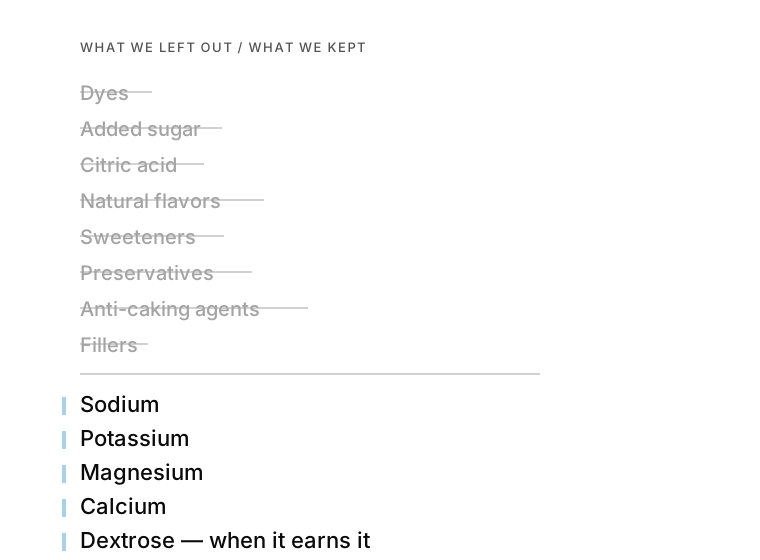
The list is short because the test is strict. Five items passed. Everything else did not.
- Sodium
- The primary electrolyte lost in sweat, the driver of fluid retention, and the ion that makes the rest of rehydration work. It is also the substrate for the sodium-glucose cotransporter — the gut-wall protein that moves fluid across the intestinal lining. Sodium is the first thing that needs replacing, and replacing it at the right concentration is what separates a rehydration drink from flavored water.
- Potassium
- Works alongside sodium in fluid balance and cellular signaling. Lost in sweat at lower concentrations than sodium, but lost consistently enough to matter, particularly in longer effort. Potassium sits inside cells; sodium sits outside them. Together they maintain the gradient that drives nerve and muscle function.
- Magnesium
- Present in sweat, required for muscle contraction, enzyme activation, and nerve signaling. The amounts lost in a typical session are smaller than sodium and potassium — replacing them costs the formula nothing, and the physiological roles are real.
- Calcium
- Also lost in sweat in small amounts, and essential to muscle contraction at the cellular level. The case for inclusion is the same as magnesium: the loss is real, the dose to replace it is small, the job it does is specific.
- Dextrose (Quick Rehydrate only)
- Glucose — which is what dextrose is — activates SGLT1, the sodium-glucose cotransporter in the gut wall. When glucose is present at the right concentration, sodium crosses the intestinal lining more rapidly, and water follows by osmosis. The mechanism is some of the most established transport physiology there is. A small dose does not make the drink meaningfully sweet or caloric — it runs the pump. Quick Rehydrate carries approximately four grams per liter for this reason and no other. The all-day Normal formula, sipped slowly across a day, does not need accelerated uptake and carries none.
What did not earn its place
Every line that was struck from the list failed the same test. Not because these things are necessarily harmful — because they are not doing a job that your body needs done.
Synthetic dyes. They make a drink look more appealing. They do nothing for electrolyte content or absorption. A real evidence trail connects them to neurobehavioral effects in some children, and the FDA revoked authorization for Red No. 3 in January 2025. With no benefit on the other side of the ledger, the decision was not close. The full case is in the dyes article.
Artificial sweeteners and flavors. They change how a drink tastes, not how it rehydrates. Taste preference is real, but it belongs to the drinker, not to the formula. An unflavored drink lets someone add what they actually want, in the amount they want, rather than accepting a preset that may not fit.
The sugar load in a typical sports drink. A typical sports drink carries fifteen to thirty-odd grams of sugar per serving. The cotransport mechanism saturates well below that level — past the glucose needed to open the pathway, additional sugar adds sweetness and calories, not absorption. Quick Rehydrate carries the functional dose and stops. Normal carries none.
Vitamins, herbs, amino acids, adaptogens. There is a long tail of additions common in the sports and wellness category — B vitamins, zinc, various plant extracts. Some are genuinely useful in other contexts. None pass the test for a product whose job is to replace what you lost in sweat. If an ingredient is not in sweat and does not help move what is, it is not in the formula.
“Just is a precision word, not a marketing word. Just this. Only this. Exactly this.”— Sol, COO, Just Electrolyte
“Just” is not minimalism
Minimalism is an aesthetic. You can be minimal and still include things that do not work. You can be elaborate and include only things that do. We are not trying to be simple — we are trying to be correct.
If there were a seventh ingredient that passed the test — that demonstrably moved fluid faster, or replaced something real that was missing — it would go in. The formula is not short because short is the goal. It is short because that is what the test produced.
This also means the formula is not finished in the sense of being sealed against revision. The physiology of hydration is well-established; the research on individual variation in sweat composition and optimal replacement continues. If good evidence shifts the answer on any of these decisions, the formula shifts with it. What does not shift is the test itself.
The same discipline that produced this list would add to it, given sufficient reason. That is a different thing from adding because addition is easy, or because something sounds like it belongs, or because a competitor has it. Those are aesthetic reasons. The test is not aesthetic.
A sol is a solution
An electrolyte is defined by what it does when it dissolves: it separates into ions that conduct charge and drive the chemistry of cells. It is not the ion by itself. It is the ion in solution — the sol. Chemistry uses the word for any stable dispersion of particles in a liquid. A sol is what you make when you dissolve something that works.
“Just electrolyte” is the plainest possible statement of what the glass contains. Not flavored electrolyte. Not electrolyte plus. Not electrolyte and vitamins and botanical extracts and a synthetic blue that makes it look like a sports drink should look. Just the thing itself, dissolved into water, doing its job.
That is what “just” means. The formula did not start as a list of things to avoid. It started as a question: what does your body actually need when it loses fluid? The answer to that question is short. The name is the answer.
This statement has not been evaluated by the Food and Drug Administration. This product is not intended to diagnose, treat, cure, or prevent any disease.
Sources
- OEHHA (California EPA). Health Effects Assessment: Potential Neurobehavioral Effects of Synthetic Food Dyes in Children. 2021. (Basis for the dye claim above; the full treatment is in the dyes article.)
- U.S. FDA. Revocation of authorization for FD&C Red No. 3 in food and ingested drugs (order January 2025; food and dietary-supplement uses end January 2027, ingested drugs January 2028).
- This article also draws on the citations across the science hub — see the dextrose, absorption, and purity articles.
- FDA, 21 CFR 101.22 — labeling of spices, flavorings, colorings, and chemical preservatives (regulatory context for “flavor” and “color additive”).
Just this
Every decision in the formula follows from a single test. The science hub maps where it leads.