Mechanism & formula
Osmolarity & absorption: why concentration governs speed
A more concentrated drink is not a stronger drink. Concentration has a direction — and when you cross the line it starts working against you. The story of why the World Health Organization lowered its oral rehydration formula explains why.
What concentration means in the gut
Osmolarity is a count: the number of dissolved particles per litre of solution. It doesn’t matter whether the particle is sodium, glucose, potassium, or a small organic molecule — each osmotically active particle contributes equally to the total, regardless of its identity or size.
- Osmolarity
- Particles per litre of solution, measured in milliosmoles (mOsm/L). Human blood plasma runs about 285–295 mOsm/L. This is the unit WHO uses to specify oral rehydration solutions, and the unit used throughout this page.
- Osmolality
- The closely related measure of particles per kilogram of solvent water (mOsm/kg). For dilute physiological fluids the two values are nearly identical, which is why they are often used interchangeably — but they are not the same quantity. Per litre of solution is osmolarity; per kilogram of water is osmolality.
- Tonicity
- A comparative term: hypertonic means more concentrated than plasma, hypotonic means less concentrated, isotonic means roughly equal. The gut wall responds to tonicity, not to the identity of the solutes.
- Osmotic pressure
- The pressure that develops across a semi-permeable membrane when concentrations differ on each side. Water tends to move toward the side with more dissolved particles, not away from it.
The gut wall is semi-permeable — it lets water through far more easily than it lets solutes through. So when the concentration of a drink differs from the concentration of the fluid on the other side of the gut wall, water moves. The direction it moves depends entirely on which side is more concentrated.
Hypertonic, isotonic, hypotonic
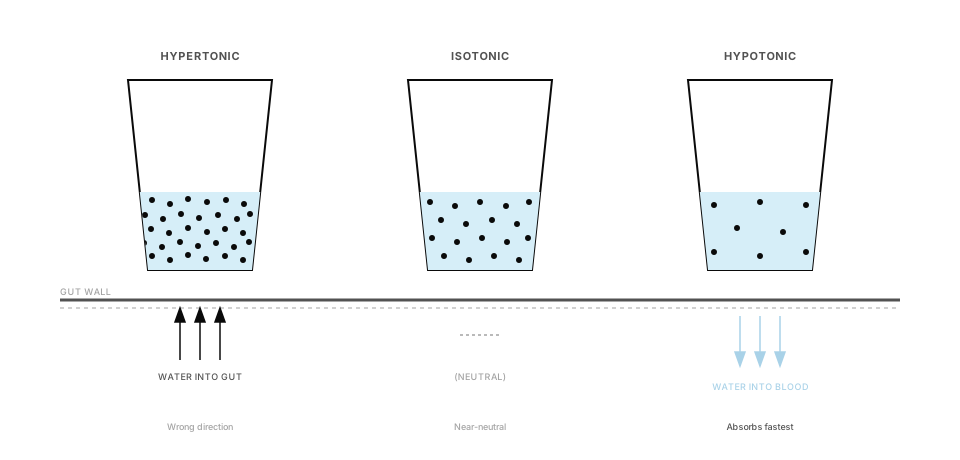
Not every concentration behaves the same. There are three distinct zones, and each has a different consequence for absorption.
~285–295 mOsm/L
blood plasma — the reference point the other two are measured against
~245 mOsm/L
the reduced-osmolarity ORS WHO adopted in 2002 — below plasma, so net water movement runs toward absorption
>300 mOsm/L
where a concentrated sweet drink can land — above plasma, drawing water into the gut and slowing you
Hypertonic (too concentrated)
- More dissolved particles in the drink than in the body’s fluid.
- Water is drawn from the gut wall into the lumen toward the higher particle count.
- Net fluid movement runs the wrong direction — the gut is taking on water even as you drink.
- Full-sugar sports drinks above about 300 mOsm/L can land here.
Hypotonic — absorbs fastest
- Fewer dissolved particles than blood plasma.
- Water moves from the gut into the blood — the direction rehydration needs.
- Sodium and glucose still cross via SGLT1; the lower osmolarity lets water follow faster.
- WHO’s reduced-osmolarity ORS (~245 mOsm/L) sits in this zone.
Isotonic sits between the two — roughly matching plasma osmolarity. Water movement is near-neutral: neither pulled in nor pushed out. Isotonic is not bad, but it is not optimal for oral rehydration, where the goal is to maximize water movement toward absorption.
Why WHO lowered the formula in 2002
The original WHO oral rehydration solution ran at about 311 mOsm/L — sodium 90 mmol/L, glucose 111 mmol/L. It worked well enough to transform cholera treatment. Then a large body of evidence showed a lower-osmolarity version worked better.
The reduced-osmolarity ORS — sodium 75 mmol/L, glucose 75 mmol/L, approximately 245 mOsm/L — was adopted by WHO and UNICEF in 2002 after clinical trials showed it reduced the volume of stool output, reduced vomiting, and reduced the need for intravenous rescue therapy in children with acute diarrhea. Less was more.
The mechanism is what you would expect from the physics. A solution closer to the body’s own osmolarity — or slightly below it — creates a smaller osmotic disturbance. The gut does not have to compensate by moving water in the wrong direction. The SGLT1 transporter still has all the glucose it needs to carry sodium across; the lower particle count just means water follows more freely.
The Cochrane review of reduced versus standard osmolarity ORS (Hahn et al.) found statistically significant benefits across multiple clinical outcomes. The evidence for going lower was strong enough that WHO revised its flagship global health formula — not a marginal footnote.
The reduced-osmolarity ORS absorbs sodium across the intestinal wall using the same SGLT1 transporter — the lower particle count simply removes an osmotic obstacle water was pushing against.
The absorption window: more isn’t better
There is a range where oral rehydration works well. Below it — pure water — you get water without electrolytes, which is fine for slow hydration but does not replace what sweat removes. Above it — hypertonic — you fight the physics. The goal is to stay inside the window.
Just Electrolyte’s formulas are designed with osmolarity in mind, not as a secondary consequence of hitting flavor targets. A concentrated sweet drink can easily tip past 300 mOsm/L. A carefully dosed mineral-and-glucose mix can sit in the 200–280 mOsm/L range — inside the absorption window.
“More electrolytes” is not a simple positive. Sodium concentration matters; so does the total particle count. A drink crammed with electrolytes, amino acids, and sweeteners at high doses can be hypertonic even if the sodium number looks reasonable. The sum of all solutes is what the gut wall sees.
The right question is not how much is in the glass. It is what the gut wall sees — and whether that concentration is helping or hindering water crossing it.
This statement has not been evaluated by the Food and Drug Administration. This product is not intended to diagnose, treat, cure, or prevent any disease.
Sources
- Buccigrossi V, Russo C, Marano A, et al. Potency of oral rehydration solution in inducing fluid absorption is related to glucose concentration. Scientific Reports 10:7803, 2020. doi:10.1038/s41598-020-64818-3.
- World Health Organization / UNICEF. Reduced osmolarity ORS formulation, 2002 — about 245 mOsm/L; sodium 75 mmol/L, glucose 75 mmol/L (about 13.5 g/L).
- Hahn S, Kim Y, Garner P. Reduced osmolarity oral rehydration solution for treating dehydration due to diarrhoea in children. Cochrane Database of Systematic Reviews 2002, Issue 1, CD002847. PMID 11869639.
- Wright EM, Loo DDF, Hirayama BA. Biology of human sodium glucose transporters. Physiological Reviews 91(2):733–794, 2011 — SGLT1 kinetics and the sodium gradient mechanism.
Dosed to the window
Osmolarity is not a feature. It is the physics the formula either works with or fights. The science hub maps the rest of the picture.