Mechanism & formula
Sodium-glucose cotransport: the discovery that moves water
There is a small protein in the lining of your gut that moves sodium and glucose across the wall together, in fixed proportion, and pulls water after them. It is some of the most thoroughly established transport physiology there is. It is also the reason a measured amount of dextrose belongs in an electrolyte drink — and the reason most of the sugar in a sports drink does not.
A gut that drank, and didn’t keep it
For most of a century, the gut looked like a contradiction. It could move enormous volumes of fluid in a day, yet pouring salt water into it did surprisingly little for someone losing fluid fast.
The numbers make the puzzle concrete. Across a day, the small intestine handles something on the order of eight to nine litres of fluid — a litre or two you drink, the rest secreted by your own stomach, pancreas, and gut — and it reabsorbs very nearly all of it. The machinery for moving water across the intestinal wall is clearly powerful. So why, in severe diarrheal illness like cholera, could a patient drink steadily and still slide toward collapse?
The answer was not a better salt or a stronger solution. Sodium does not cross the gut wall on its own in the quantities rehydration needs. Something has to carry it — actively, against the odds — and until the mid-twentieth century no one had described what. The missing piece turned out to be a partnership between sodium and an unlikely collaborator: sugar.
8–9 L
fluid the small intestine reabsorbs in a single day
2:1
sodium ions SGLT1 carries across for every glucose molecule
1978
the year a Lancet editorial called this coupling potentially the most important medical advance of the century
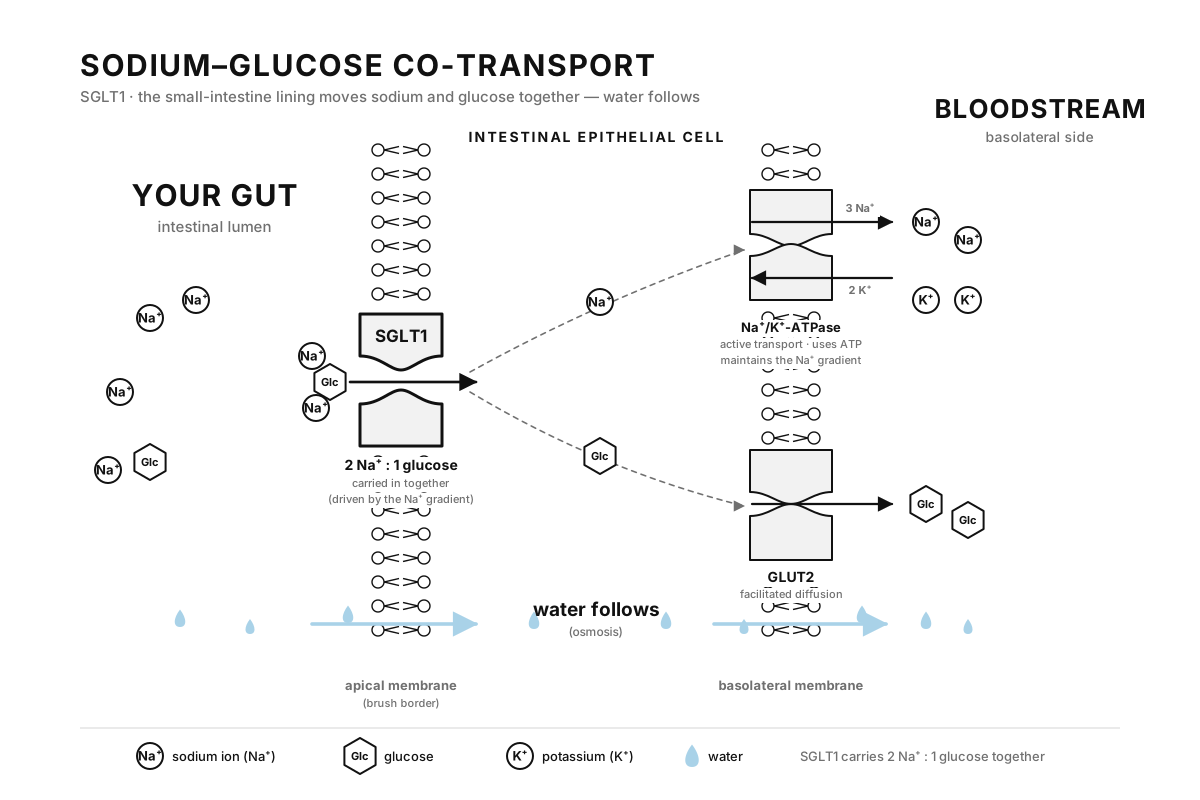
Glucose is the key that turns the lock
Around 1960, the physiologist Robert Crane proposed how it works. The model has four moves, and it has held up for sixty years.
The cell sets a gradient
A pump in the cell membrane, the sodium-potassium ATPase, continuously moves sodium out of the cell. That keeps the sodium concentration inside low — a stored gradient, like water held behind a dam. This is the only step that spends energy directly.
SGLT1 loads its cargo
On the brush border — the absorptive surface facing the gut — sits the transporter SGLT1. It binds two sodium ions and one glucose molecule at once. It will not carry sodium without glucose, or glucose without sodium. Both, or neither.
The gradient does the work
Sodium rushes down its gradient into the cell, and because it is bound to glucose, it drags the glucose in with it — uphill, against glucose’s own concentration. Physiologists call this secondary active transport: no extra fuel at the transporter itself, just the stored sodium gradient being spent.
Water follows
Sodium and glucose now sit on the far side of the wall, raising the solute concentration there. Water follows by osmosis. Salt and a little sugar, together, pull fluid across the lining in a way salt water alone cannot.
The transporter was cloned and sequenced in 1987, and its structure and kinetics have been mapped in fine detail since. The two-for-one stoichiometry, the dependence on the sodium gradient, the coupling to water: none of it is in dispute. It is textbook physiology, taught in every medical program. The mechanism is not novel, and it is not ours. We just dose to it.
Why this beats salt water
The same volume of sodium absorbs very differently depending on whether a little glucose is along for the ride.
Plain salt water
- Sodium reaches the gut, but has no dedicated fast path across the wall.
- Uptake is slow and limited relative to need.
- Make it concentrated enough to matter and it can turn hypertonic — drawing water into the gut, the opposite of what you want.
Salt + a little glucose
- SGLT1 engages: sodium and glucose cross together, actively.
- Water follows the sodium across by osmosis.
- The same sodium is absorbed faster and more completely — the basis of oral rehydration therapy.
That difference is not a marginal optimization. It is the difference that let a simple mixture of water, salt, and sugar rehydrate people by mouth who would otherwise have needed an intravenous line — a therapy simple enough to mix from a packet and cheap enough to reach anywhere. The full story is its own article: oral rehydration therapy.
A 1978 editorial in The Lancet assessed the discovery that sodium and glucose transport are coupled in the small intestine — so that glucose accelerates the absorption of solute and water — as potentially the most important medical advance of the century.— paraphrased from an unsigned editorial, The Lancet, 5 August 1978
A dose with a ceiling
~4 g/L
dextrose in Quick Rehydrate — the functional dose
~2.4 g
glucose per 20 fl oz bottle — enough to open the pathway, not to taste sweet
0 g
dextrose in the all-day Normal formula, which doesn’t need accelerated uptake
Here is the part that decides a formula. SGLT1 saturates. There is a finite amount of transporter, and once enough glucose is present to run it, more glucose adds nothing to absorption. Past that point the extra sugar is just sugar — and it is not free. Every additional gram raises the osmolarity of the drink, and a drink that gets too concentrated turns hypertonic and pulls water the wrong way, into the gut. More sugar can make a rehydration drink absorb worse, not better.
This is exactly why the World Health Organization lowered the sugar and salt in its oral rehydration formula in 2002: the reduced-osmolarity version absorbs more effectively than the older, stronger one. The lesson generalizes. We dose Quick Rehydrate to the floor the mechanism needs — about four grams of dextrose per litre — and stop. The all-day Normal formula, sipped slowly across a gallon, never needs accelerated uptake at all, so it carries none.
Quick Rehydrate — per 20 fl oz sachet Na 469 mg K 117 mg Mg 14 mg Ca 12 mg Dextrose ~2.4 g
This statement has not been evaluated by the Food and Drug Administration. This product is not intended to diagnose, treat, cure, or prevent any disease.
The same trick, elsewhere in the body
SGLT1 is one member of a family of sodium-coupled transporters, and its relatives are among the most studied proteins in modern medicine.
- SGLT1 — the gut
- Carries two sodium ions per glucose across the intestinal wall. The workhorse of oral rehydration, and the one we dose to.
- SGLT2 — the kidney
- Carries one sodium per glucose, and reclaims most of the glucose your kidneys filter. It is the target of the “-flozin” drugs — a major class of treatments for type-2 diabetes and heart failure — which work by blocking it so glucose leaves in the urine.
The point of naming the family is not to borrow its medicine — we are not a drug and make no such claim. It is to be clear about how settled this science is. Sodium-coupled transport is not a fringe idea or a marketing mechanism. It is bedrock physiology, and the small dose of dextrose in Quick Rehydrate is simply the most ordinary application of it.
Sources
- Crane RK. Hypothesis for mechanism of intestinal active transport of sugars. Federation Proceedings 21:891–895, 1962 — the published form of the sodium-glucose cotransport proposal Crane first presented at a 1960 symposium in Prague.
- Hediger MA, Coady MJ, Ikeda TS, Wright EM. Expression cloning and cDNA sequencing of the Na⁺/glucose cotransporter. Nature 330:379–381, 1987 — the cloning and sequencing of SGLT1.
- Wright EM, Loo DDF, Hirayama BA. Biology of human sodium glucose transporters. Physiological Reviews 91(2):733–794, 2011 — SGLT1/SGLT2 structure, the ~2 Na⁺ : 1 glucose stoichiometry, and kinetics.
- Water with sugar and salt [unsigned editorial]. The Lancet 1978 Aug 5;2(8084):300–301 (PMID 79090) — the editorial that called the coupling of sodium and glucose transport potentially the most important medical advance of the century. (Some databases index this issue under the continuous volume number 312.)
- Buccigrossi V, Lo Vecchio A, Bruzzese E, et al. Potency of oral rehydration solution in inducing fluid absorption is related to glucose concentration. Scientific Reports 10:7803, 2020. doi:10.1038/s41598-020-64818-3.
- Hall JE, Hall ME. Guyton and Hall Textbook of Medical Physiology — daily intestinal fluid load and absorption (roughly 9 L presented to the small intestine each day, the great majority reabsorbed).
Dosed to the mechanism
Every number on this page appears again on the label, per format. The science hub maps the rest of the picture.