Purity & safety
Heavy metals in supplements: the problem nobody prints on the label
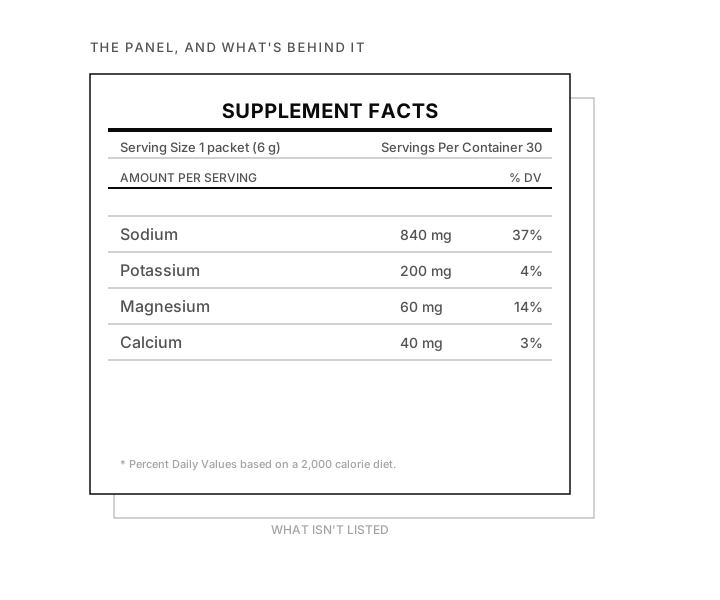
The Supplement Facts panel tells you what was added. It does not tell you what came along. Independent testing repeatedly detects arsenic, cadmium, lead, and mercury in popular supplement products — and no federal standard currently sets a specific limit for any of them in this category.
The panel lists what was added — not what came along
Independent testing organizations have found a consistent pattern across more than a decade of supplement investigations: detectable levels of arsenic, cadmium, lead, and mercury in products that make no mention of them. The contaminants are not added deliberately. They are inherited — present in raw ingredients before any manufacturer touches them, and often concentrated by the processing that turns those ingredients into a powder or tablet.
In its 2024–25 protein powder report (published January 2025), the Clean Label Project tested 160 top-selling protein powders from 70 brands and reported that 47% exceeded at least one federal or state regulatory threshold for a heavy metal — including California’s Proposition 65 limits — and that 21% exceeded twice the Prop 65 threshold for at least one metal. Consumer Reports tested 23 protein powders and shakes in 2025 and reported that roughly two-thirds contained more lead in a single serving than its experts consider safe in a day. These are not one-off findings; they are a pattern that has repeated across independent investigations over more than a decade.
Understanding why requires a short step backward into where the metals come from — because the source is not the factory. It is the field.
~47%
of protein powders tested by the Clean Label Project (2024–25 report) exceeded at least one federal or state regulatory threshold for a heavy metal, including Prop 65 — as reported by the Clean Label Project
~21%
exceeded twice the Prop 65 threshold for at least one metal — as reported by the Clean Label Project (2024–25 report)
~⅔
of protein powders and shakes tested by Consumer Reports (2025) contained more lead per serving than its experts consider safe in a day — as reported by Consumer Reports
All figures above are third-party findings reported by the cited sources. They reflect Prop 65 thresholds, which are California-specific limits that include large safety margins and are not equivalent to federal benchmarks. See the counterpoint section below for context.
Soil, water, and the concentration problem
Arsenic, cadmium, and lead exist naturally in soil and rock. Plants uptake them through their root systems as they would any mineral, in proportion to what the soil contains. Certain agricultural regions — particularly those with high-arsenic groundwater used for irrigation, or soils with elevated cadmium from phosphate fertilizer application — produce crops with measurably higher contamination. Rice and certain protein crops grown in these regions carry the signature of the ground they grew in.
Mercury enters the chain differently, primarily through industrial emission and its settling into water bodies, from which it accumulates in fish and marine-derived ingredients. Lead enters through multiple routes: soil, old industrial sites, processing equipment, and in some cases packaging.
Processing concentrates the problem. When you start with a crop and reduce it to a protein isolate or extract, you remove water, fiber, and carbohydrate — but you do not remove metal contaminants in proportion. A protein concentrate at 70 percent purity carries a higher metals burden per gram than the original crop at 35 percent protein. Concentration is the word that matters: the supplement form can deliver a higher elemental burden per serving than the whole food equivalent would.
Two of the four metals assessed most often in supplement testing — arsenic and cadmium (and their compounds) — are classified as Group 1 human carcinogens by the International Agency for Research on Cancer (IARC). Inorganic lead is classified as probably carcinogenic (Group 2A) and methylmercury as possibly carcinogenic (Group 2B). At the trace levels found in food and supplements, dose and duration are the key variables in assessing risk, not the mere fact of detection.
What the findings say, and what the industry says back
The findings
- Clean Label Project (2024–25 report): ~47% of tested protein powders above at least one federal or state regulatory threshold, including Prop 65; ~21% above twice the Prop 65 threshold for at least one metal.
- Consumer Reports (2025): ~two-thirds of 23 protein powders and shakes tested contained more lead per serving than its experts consider safe in a day.
- Pattern has repeated across independent investigations over more than a decade.
- No federal standard currently requires disclosure or remediation.
The industry’s response
- Council for Responsible Nutrition and NSF International: Prop 65 thresholds are not federal safety standards. The Prop 65 maximum allowable dose level for lead is 0.5 µg/day, well below the FDA’s interim reference level of 12.5 µg/day for adults.
- Dose matters: a trace amount at a level found in common foods is not the same exposure as a chronic daily serving accumulating over years.
- Third-party certification programs (NSF, USP) already test for contaminants; voluntary compliance is meaningful even absent a mandate.
- Some manufacturers say they have since retested or reformulated flagged products.
The honest synthesis is that both things are true: the independent testing findings are real and documented, and the appropriate threshold for concern is a legitimate area of scientific debate. Where the two sides agree is that testing is the only way to know what a specific product actually contains. A number on an independent lab report is verifiable; an assurance on a marketing page is not.
The EU sets contaminant limits. The US does not — for supplements.
DSHEA
1994 US law governing supplements: requires safety but sets no contaminant-specific limits for heavy metals in this category
EU 2023/915
European Commission regulation: sets maximum levels for As, Cd, Pb, and Hg across specific food categories
Voluntary
NSF Certified for Sport and USP Verification do test for contaminants — but certification remains opt-in, not required
Under current US law, there is no federal regulation that sets specific maximum levels for arsenic, cadmium, lead, or mercury in dietary supplements as a product category. The FDA regulates supplements under the Dietary Supplement Health and Education Act of 1994 (DSHEA), which requires manufacturers to ensure safety but does not establish contaminant-specific thresholds the way FDA regulations govern heavy metals in bottled water or candy marketed to children.
The contrast with the European Union is significant. The European Commission’s Regulation (EU) 2023/915 establishes maximum levels for a range of contaminants in food — including lead, cadmium, mercury, and inorganic arsenic — across specific food categories, and replaced the earlier Regulation (EC) No 1881/2006. EU food businesses must test against those limits. The US supplement market currently has no equivalent category-specific requirement.
The answer to a regulatory gap, in our view, is not to point at it but to plan to fill it. Our commitment — once a first batch is produced and tested — is batch-level heavy-metals testing by an accredited independent lab, with the results published. We are not claiming any test result or certification here, because no batch has been made yet. We are describing the standard we intend to hold ourselves to, and why we think it matters for anything people ingest daily.
This statement has not been evaluated by the Food and Drug Administration. This product is not intended to diagnose, treat, cure, or prevent any disease.
Sources
- Clean Label Project. Protein Powder Category Report (2024–25), published January 2025: 47% of products tested exceeded at least one regulatory threshold, including Prop 65. cleanlabelproject.org.
- Consumer Reports. “Protein Powders and Shakes Contain High Levels of Lead,” October 2025: of 23 products tested, roughly two-thirds exceeded CR’s lead level of concern per serving. consumerreports.org.
- Council for Responsible Nutrition. “Ensuring Safety and Transparency in Dietary Supplements: A Response to the Clean Label Project’s Protein Powder Report,” 2025 — industry context on Prop 65 versus federal benchmarks. crnusa.org.
- Commission Regulation (EU) 2023/915 of 25 April 2023 on maximum levels for certain contaminants in food, repealing Regulation (EC) No 1881/2006 — illustrative of category-specific limits the US supplement market currently lacks.
- International Agency for Research on Cancer (IARC) Monographs — carcinogenicity classifications for arsenic and cadmium (Group 1), inorganic lead (Group 2A), and methylmercury (Group 2B).
- European Food Safety Authority (EFSA) — Scientific Opinions on tolerable intakes for lead, cadmium, inorganic arsenic, and methylmercury, in the EFSA Journal (dose-based risk context for trace metals).
The label is not the whole story
The science hub covers how testing actually works — and what to look for in a Certificate of Analysis.
This article is educational and discusses the supplement category broadly. This statement has not been evaluated by the Food and Drug Administration. This product is not intended to diagnose, treat, cure, or prevent any disease.