Use cases · practical
Sweat-rate math: estimate your own losses
Population averages tell you what a typical athlete loses. They do not tell you what you lose. A scale, a timed session, and a short calculation turn body-mass change into a personal sweat rate — and, layered with a sodium estimate, into a per-hour replacement target specific to you.
Why averages don’t help you
The case for knowing your own number starts with recognizing how much individual variation exists. Sweat rate across athletes spans roughly 0.5 to 2.5 litres per hour depending on intensity, conditions, and the individual. Sweat sodium concentration ranges from around 10 to 90 mmol/L between people — a roughly nine-fold spread, with about one in five endurance athletes sitting above 60 mmol/L.
The full picture on sodium variation is in the companion article, The salty sweater. The practical point here: the same guidance cannot serve both ends of those distributions. If you are a high-sweat-rate, high-sodium sweater and you follow a generic recommendation calibrated to the middle, you will chronically underreplace — particularly on long sessions in the heat. The only way out of that is a personal measurement. The good news is that the core measurement is simple.
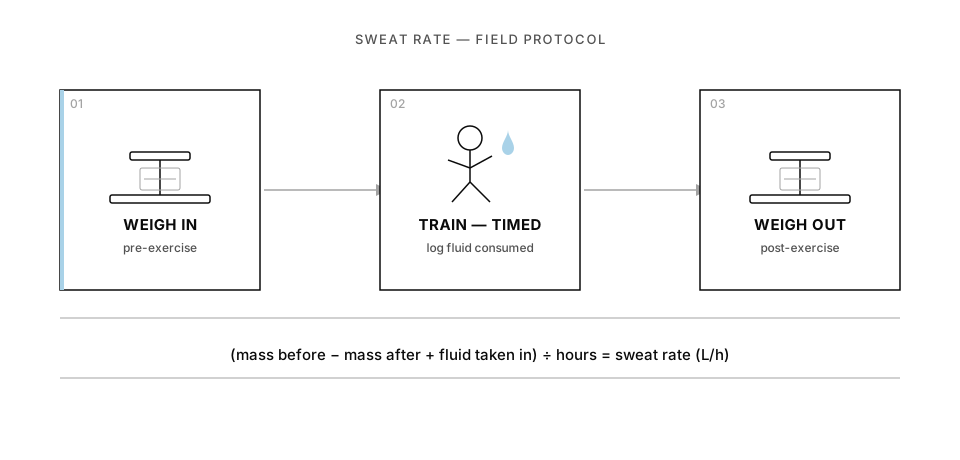
Weigh in, train, weigh out
The underlying logic is simple: in a short-to-medium session, almost all body-mass change is explained by fluid loss. One kilogram of mass lost corresponds to approximately one litre of sweat.
Weigh in — nude, post-void
Step on the scale immediately before the session in minimal or no clothing, after urinating. Record the number. Consistency matters more than precision: the same protocol before and after is what makes the difference meaningful.
Train for a measured time
Go for a timed session — ideally 60–90 minutes — in conditions representative of your target events. If you drink during the session, weigh your bottle before and after so you know exactly how much you consumed. If you can tolerate a no-drink trial, it simplifies the arithmetic.
Towel off and weigh out
Return to the scale immediately after the session — same clothing state, before eating or drinking again. Towel off any visible sweat on the skin. If you urinated during the session, estimate that volume and add it back in for the calculation.
Add back fluid consumed, divide by hours
Apply the equation: Sweat loss (L) = (mass before − mass after) + fluid consumed − urine produced. Then Sweat rate (L/hr) = sweat loss ÷ session duration in hours. This is your per-hour fluid loss under those conditions.
Optionally layer sweat sodium
If you have a sweat sodium estimate from a lab patch, multiply your sweat rate by that concentration to get a per-hour sodium loss. At 1.5 L/hr and 50 mmol/L, that is 75 mmol/hr — about 1.7 g of sodium per hour. If you do not have a lab number, field signs from the salty-sweater article are a starting point.
~1 kg of body mass lost during exercise corresponds to approximately ~1 L of sweat — after correcting for any fluid consumed during the session. This approximation holds well for sessions under two hours at moderate intensity; longer or more extreme efforts warrant a lab sweat test for added confidence.
Round numbers, real arithmetic
The table below shows a worked example with round numbers. All values are approximate and intended as illustration.
| Variable | Value | Note |
|---|---|---|
| Mass before | 75.0 kg | Nude, post-void |
| Mass after | 73.6 kg | Same conditions, toweled off |
| Fluid consumed | 0.5 L | Weighed bottle before and after |
| Urine produced | 0 L | None during session |
| Session duration | 1.0 hr | 60-minute run |
| Sweat loss | 1.9 L | (75.0 − 73.6) + 0.5 = 1.9 |
| Sweat rate | ~1.9 L/hr | 1.9 ÷ 1.0 |
| Sweat sodium (lab estimate) | 50 mmol/L | Hypothetical lab patch result |
| Sodium loss rate | ~95 mmol/hr | 1.9 L/hr × 50 mmol/L ≈ 2.2 g Na/hr |
The sweat rate is the fluid half of the picture. The sodium half requires a sweat sodium estimate — either from a laboratory sweat patch (the precise route) or from field signs described in the companion article. Field signs are proxies, not measurements. They point toward the high end of the distribution but cannot quantify where on it you fall. A lab patch is worth running if you have the access; the field signs are a reasonable starting point while you arrange it.
Turn it into a per-hour target
0.8–1.0 L/hr
commonly cited gastric-emptying ceiling for most people — a practical upper bound on replacing fluid during exercise
~1 kg
mass lost ≈ ~1 L of sweat — the conversion the whole method rests on
~2×
how much sweat rate can vary for the same person between cool and summer-heat conditions
Once you have a sweat rate for a given set of conditions, you have a per-hour fluid replacement target. The goal during exercise is not to replace 100% in real time — gastric emptying sets a practical ceiling, commonly cited around 1 L/hr for most people, though it varies with drink composition and the individual — but to minimize the deficit and correct it promptly in recovery. A measured rate tells you what gap you are managing.
The important caveat: sweat rate varies with conditions. A 1.9 L/hr result from a 20°C morning run may become 2.5 L/hr in afternoon summer heat and drop to 1.3 L/hr in cool weather. Sweat sodium concentration is more stable across conditions but also shifts with heat acclimatization status and, to a lesser degree, diet. The number you measure is a data point, not a fixed constant. Re-measuring across different heat and intensity conditions gives a more complete picture.
The proxy calculation here is honest about its limits. Body-mass change overstates sweat loss slightly because a small amount of mass is also lost as respiratory water vapor and oxidized fuel substrate, and the correction for fluid consumed is itself an estimate. For sessions under two hours at moderate intensity, these errors are modest and the weigh-in / weigh-out method is close enough to be useful. For longer races or extreme heat, a lab sweat test gives more confidence.
This statement has not been evaluated by the Food and Drug Administration. This product is not intended to diagnose, treat, cure, or prevent any disease. The information on this page is general information and is not a substitute for individualized medical or nutritional advice from a qualified professional.
Sources
- Baker LB. Sweating rate and sweat sodium concentration in athletes: a review. Sports Medicine 47(Suppl 1):111–128, 2017 — sweat-testing methodology, sweat rate and sodium variation, field vs laboratory approaches.
- Gatorade Sports Science Institute — sweat-testing best practices and the weigh-in / weigh-out protocol. gssiweb.org (accessed 2026).
- Barnes KA, Anderson ML, Stofan JR, et al (Baker LB, senior author). Normative data for sweating rate, sweat sodium concentration and sweat sodium loss in athletes: an update and analysis by sport. Journal of Sports Sciences 37(20):2356–2366, 2019 — reference values for sanity-checking individual results.
Your number, not the average
The science hub maps the full picture — from individual variation to absorption mechanism to the risk at the other end.