Use cases
The salty sweater: why sweat sodium varies so much
Sweat is not a fixed recipe. The sodium concentration in sweat ranges roughly nine-fold between people — from about 10 to 90 mmol/L — and roughly one in five athletes loses enough to earn the label “salty sweater.” Generic hydration guidance is built for the middle. If you are not the middle, it fails you.
Sweat is not a fixed recipe
Most hydration advice starts from a shared assumption: sweat is sweat. You lose fluid, you replace fluid. Salt goes out, some generic salt comes back in. The formula is universal, the amounts are averages, and the averages work well enough for most people most of the time.
The assumption is not quite right. Sweat is produced by roughly two to four million eccrine sweat glands distributed across your skin, and what those glands put out — how much fluid per hour, and how concentrated that fluid is in sodium — varies considerably from person to person. The variation in sweat rate gets most of the attention. The variation in sodium concentration is just as real and, for a subset of athletes, a great deal more consequential.
Baker’s 2017 review of sweat sodium data across athletes puts the inter-individual range at roughly 10 to 90 mmol/L. That is approximately a nine-fold spread from the low end to the high end. The distribution is not flat — most people cluster in the middle — but the tails are real and populated.
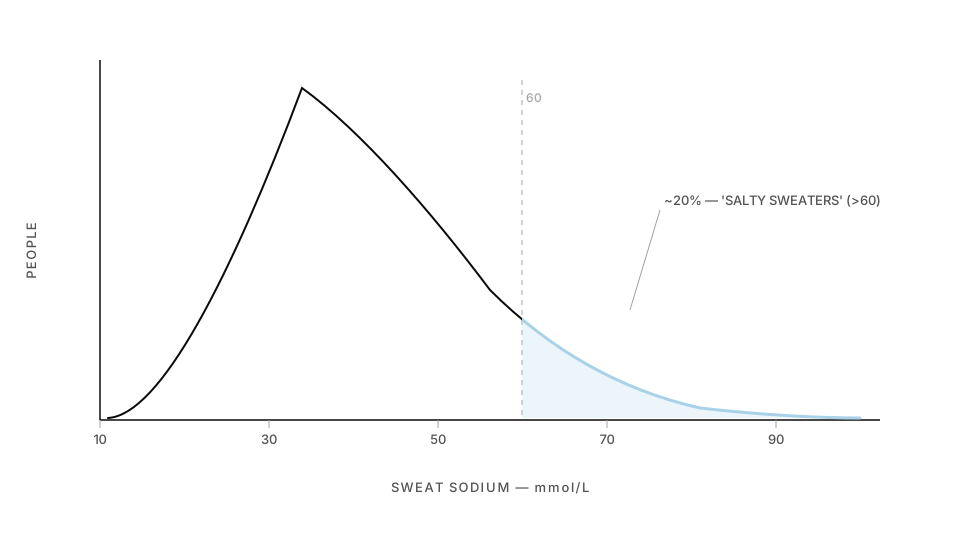
~9×
inter-individual range in sweat sodium concentration
10–90
mmol/L — the span from the low end to the high end
~1 in 5
endurance athletes sit above ~60 mmol/L — the salty-sweater range
Why some people sweat saltier than others
Eccrine glands produce sweat in two stages. What leaves your skin is the result of both stages — and the second stage is where the variation lives.
The secretory coil generates a fluid whose sodium concentration is close to plasma — roughly 140 mmol/L. As that fluid travels up the duct to the skin surface, a reabsorption step pulls sodium back out. The final sweat is much more dilute. How efficiently that duct reabsorbs sodium determines your sweat sodium concentration.
The drivers of reabsorption efficiency are several. Genetics — including variants in the cystic fibrosis transmembrane conductance regulator (CFTR) — affect duct sodium transport and appear to be the dominant factor. Sweat rate itself plays a role: at higher flow rates, fluid moves through the duct faster, leaving less time for reabsorption, which raises sodium concentration in the final product. Heat acclimatization runs the other direction — the aldosterone-mediated adaptation to repeated heat exposure improves ductal reabsorption, reducing sweat sodium concentration over weeks of training in the heat.
None of these factors can be read from the outside. Two athletes of similar fitness, training load, and diet can have sweat sodium concentrations that differ by a factor of three or more.
Low-sodium sweater
- Sweat sodium roughly 10–30 mmol/L
- Highly efficient ductal reabsorption
- Generic or low-sodium products are adequate
- Sodium deficit after a two-hour session: modest
High-sodium sweater (“salty sweater”)
- Sweat sodium roughly 60–90+ mmol/L
- Lower ductal reabsorption efficiency, often genetic
- Needs meaningfully higher sodium replacement
- Sodium deficit after a two-hour session: substantial
- Potassium — a useful contrast
- Sweat potassium concentration also varies between people, but the range is far narrower — typically 4 to 8 mmol/L. Potassium replacement, while worth including, is a less individualized problem. Sodium is where the variance lives.
How to recognize it without a lab
A laboratory sweat patch gives you a precise number. In the absence of one, there are proxy signs that correlate with high sweat sodium — useful for raising the hypothesis, not for quantifying it.
Salt crust on a cap brim or helmet
Sodium chloride precipitates as sweat evaporates. A visible white crust around the brim of a training cap, the edge of a helmet, or on a headband is one of the stronger proxy signs — it requires a substantial concentration to leave a visible deposit.
White residue on a dark shirt
Salt lines or a diffuse white film on a dark training shirt after the sweat dries. The residue is particularly visible at the collar, underarms, or anywhere sweat pools and then evaporates repeatedly during a long session.
Gritty or crystalline skin texture post-session
Running a finger across the forearm or face after a session and feeling a slightly gritty or crystalline texture — dried salt crystals on the skin surface. A low-sodium sweater typically has clean, smooth skin after the sweat dries.
Stinging or burning eyes during exercise
Sweat running into the eyes stings for everyone, but a high-sodium sweater tends to find it more pronounced. The mechanism is straightforward: more sodium chloride in the sweat means a more irritating solution reaching the eyes.
These signs occur because sodium chloride precipitates as water evaporates, and a high-sodium sweater leaves more behind. The absence of visible residue does not rule out high sweat sodium — it depends on sweat rate and concentration threshold — but its presence is a reasonable signal worth following up with a proper test.
“The same guidance cannot serve both ends of the distribution. If you are a high-sweat-rate, high-sodium sweater and you follow a generic recommendation calibrated to the middle, you will chronically underreplace.”— The case for measuring your own number
Why generic guidance fails the high end
Population-average sodium replacement targets are built around the population mean. They work reasonably well for the people closest to that mean. For the tails — especially the high end — they can miss by a wide margin.
In a 2016 study of 157 endurance runners, Lara and colleagues measured sweat sodium spanning nearly the whole plausible range — roughly 7 to 95 mmol/L, around a mean near 43 mmol/L — and a substantial minority sat high enough to warrant an individualized sodium strategy. Practitioners commonly draw the salty-sweater line around 60 mmol/L; by that practical threshold, roughly one in five endurance athletes qualifies. Above it, a two-hour training run is not a mild salt deficit. It is a meaningful one, and replacing it with a low-sodium drink or plain water can leave the gap wide open.
A salty sweater training two hours in summer heat may lose two to three times the sodium a low-sodium sweater would lose in the same session. If both follow the same replacement guidance, one of them finishes the session in significantly better shape — and it is not luck. It is individual variation that the guidance never accounted for.
The practical response is to know your own number. A weigh-in / weigh-out protocol to estimate sweat rate, combined with either a lab sodium test or the field-sign proxy, gives you a personal target that no average can provide. That arithmetic is in the companion article: Sweat-rate math: estimate your own losses.
This statement has not been evaluated by the Food and Drug Administration. This product is not intended to diagnose, treat, cure, or prevent any disease. The information on this page is general information and is not a substitute for individualized medical or nutritional advice from a qualified professional.
Sources
- Baker LB. Sweating rate and sweat sodium concentration in athletes: a review. Sports Medicine 47(Suppl 1):111–128, 2017. doi:10.1007/s40279-017-0691-5 — inter-individual range (~10–90 mmol/L), eccrine reabsorption mechanism, and drivers of variation.
- Barnes KA, Anderson ML, Stofan JR, et al (Baker LB, senior author). Normative data for sweating rate, sweat sodium concentration and sweat sodium loss in athletes: an update and analysis by sport. Journal of Sports Sciences 37(20):2356–2366, 2019 — sport-specific sweat sodium reference values.
- Lara B, et al. Interindividual variability in sweat electrolyte concentration in marathoners. Journal of the International Society of Sports Nutrition 13:31, 2016 — sweat sodium ~7–95 mmol/L (mean ~43) across 157 endurance runners; wide interindividual variability.
Know your number
The science hub maps the rest of the picture — from the mechanism of absorption to the math behind your personal sweat rate.