Use cases
Electrolytes & daily hydration
Electrolyte loss does not require exercise. You lose sodium, potassium, and magnesium through urine, through low-level baseline sweating, through breathing — all day, regardless of whether you move. Modern Western diets are already short on potassium and magnesium for most adults. The all-day formula exists for this case: a low, steady concentration added to a gallon of water, sipped from morning to night.
You lose electrolytes without moving
Exercise is the dramatic version of electrolyte loss. Baseline physiology is the quiet, continuous one.
Electrolytes are regulated solutes. The body maintains tight concentration ranges for sodium, potassium, magnesium, and other ions in blood and intracellular fluid — and it maintains them through constant active adjustment. The kidneys filter electrolytes continuously, reabsorbing what is needed and excreting the rest in urine. Sweat glands produce a trickle of fluid even at rest. The gastrointestinal tract moves enormous volumes of fluid and electrolytes in the course of a day, most of it recycled but some lost through normal excretion.
These are not dramatic losses. At steady state the body excretes roughly as much sodium as it takes in, so a sedentary adult on a temperate day turns over on the order of a gram or two of sodium daily through normal excretion — varying significantly by diet, kidney function, and individual physiology. Potassium losses through urine can be substantial, particularly with diets low in fruits and vegetables. Magnesium losses are modest in absolute terms but land on an already thin baseline: national dietary surveys consistently find a large share of Americans — on the order of half — consuming less magnesium than the Estimated Average Requirement.
The argument for daily electrolyte supplementation does not rest on dramatic deficiency. It rests on the quieter observation that baseline losses are real and steady, dietary coverage is often incomplete, and the cost of a small daily correction is low while the habit of well-hydrated cells is meaningfully positive.
~48%
of Americans estimated to consume less magnesium than the Estimated Average Requirement (NHANES 2013–2016, as reported by the NIH Office of Dietary Supplements)
3,400 / 2,600 mg/day
the potassium Adequate Intake for adult men / women (National Academies, 2019) — a level most adults fall short of
1 gallon
a common daily hydration target for active adults — the right volume to carry a steady low-concentration electrolyte dose across the day
Modern diets are short on potassium and magnesium
The typical Western diet delivers more sodium than the body needs and less potassium and magnesium than it benefits from. This asymmetry has practical implications for daily electrolyte choices.
Sodium is abundant in processed food — so much so that the major dietary concern for the general population is excess, not deficit. Potassium is the opposite: its richest dietary sources are fruits, vegetables, legumes, and nuts. Diets built heavily around packaged foods, fast food, and refined carbohydrates tend to deliver a fraction of the potassium Adequate Intake. The 2019 National Academies Dietary Reference Intakes for Sodium and Potassium identified adequate potassium intake as a consistent challenge for most American adults.
Magnesium occupies a similar position. Whole grains, nuts, seeds, and leafy greens are the primary sources. Refining grains removes a substantial portion of their magnesium content. The result, documented repeatedly in NHANES dietary surveys, is that the majority of adults consume less than the estimated Average Requirement for magnesium — not a clinical deficiency in most cases, but a chronic background shortfall.
None of this suggests a supplement in place of food. It suggests that an electrolyte formula designed for daily use should address the actual gap: more potassium and magnesium as a proportion of the dose, with sodium at a modest level appropriate for someone who is not exercising. A daily-hydration formula is not a sports drink. The concentrations are lower, the sodium is restrained, and the potassium-to-sodium ratio is different from what an athlete sweating heavily needs.
Sports / exercise formula
- Higher sodium: matches elevated sweat sodium losses
- Consumed with or immediately around exercise
- Volume may be large over a session
- Possibly with dextrose for accelerated uptake
Daily / normal formula
- Lower, steadier sodium: suitable for non-exercise periods
- Higher potassium and magnesium as a proportion of dose
- Distributed across the day with drinking water
- No added sugar needed — the goal is not rapid uptake
The Just Electrolyte Normal formula is calibrated for this use case. See the electrolyte ratios for how the numbers were set.
Desk work, travel, heat, recovery, and older adults
Daily electrolyte supplementation is not exclusively an athlete’s tool. Several non-exercise circumstances create conditions where it is useful.
Desk work and sedentary days
A person sitting at a desk all day may drink a gallon of plain water over the course of it — a habit that works against electrolyte balance in a quiet way. Plain water at high volumes dilutes urine sodium, which triggers mild renal sodium losses as the kidney responds. A low-concentration electrolyte in the water does not add a large dose; it simply prevents the diluting effect of high plain-water intake from nudging the body toward mild electrolyte depletion.
Travel, particularly air travel
Airplane cabin air is exceptionally dry — relative humidity is typically 10–20%, far below the 30–60% of most indoor environments. Insensible losses (from skin and breathing) increase in dry air. Flights produce meaningful fluid and electrolyte depletion over several hours, compounded by the tendency to drink less during travel than at a desk. An electrolyte-supplemented water bottle is a straightforward countermeasure.
Hot climates and outdoor environments
Even without formal exercise, sustained exposure to heat increases baseline sweat rate. A person doing light yard work for three hours in 90°F heat may lose more electrolytes than a person doing 45 minutes of moderate gym work. The “it’s not really exercise” framing misses the physiology: the body sweats in response to thermal load, not cardiovascular intensity.
Recovery after hard training
The 12 to 24 hours after a long or intense workout involve continued rehydration and electrolyte repletion. Drinking plain water to recover volume without accompanying sodium can prolong the repletion process — the body excretes the hypotonic load rather than retaining it. A low-concentration electrolyte drink during the recovery window supports restoration of both fluid volume and electrolyte balance more efficiently than water alone.
Older adults
Thirst sensation diminishes with age, and kidney regulation of sodium and fluid becomes less precise. Older adults are at elevated risk of both dehydration and electrolyte imbalance, and are less likely to respond appropriately to the signals that prompt younger people to drink. A structured daily electrolyte habit — a fixed amount added to water at fixed times — removes the reliance on thirst and provides a consistent background of electrolyte support.
This statement has not been evaluated by the Food and Drug Administration. This product is not intended to diagnose, treat, cure, or prevent any disease.
A little, steadily, not a spike
The physiology of daily electrolyte needs does not call for a concentrated hit. It calls for a steady background.
Kidney and cellular regulation of electrolytes operates continuously, not in single daily doses. A high-concentration electrolyte drink consumed once — a full exercise sachet dropped into 12 ounces of water and gulped — presents a bolus load that the kidney handles efficiently: it excretes the excess. The signal the cell sees is a brief spike, not a sustained supply.
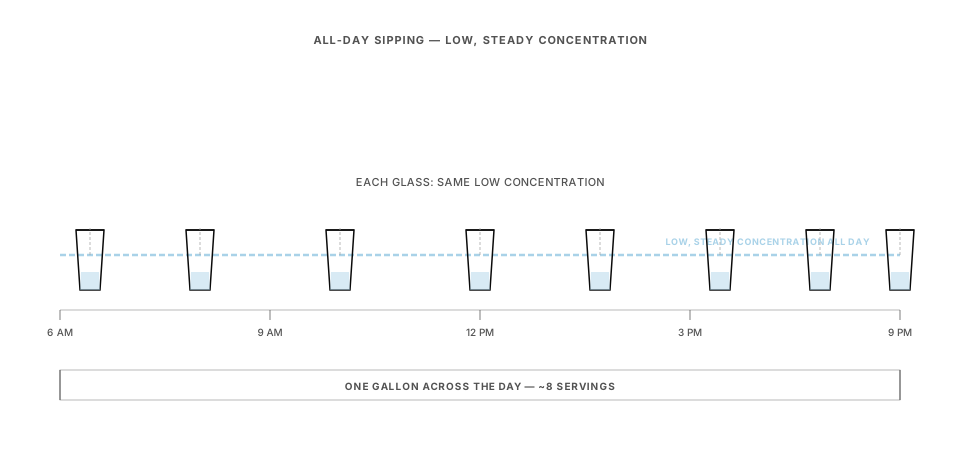
The all-day pattern does the opposite. One serving of Normal added to a liter of water — or proportionally across a full gallon, refilled across the day — delivers a concentration so low that it is essentially invisible osmotically. The body does not need to compensate. Every sip moves a small amount of sodium, potassium, and magnesium into the system, continuously, matching the pace of continuous baseline loss. The kidney does not need to excrete a bolus because there is no bolus to excrete.
This is not a complicated protocol. Fill a water bottle or gallon jug. Add Normal. Drink it over the course of the day, as you would drink plain water. The concentration does the work; the timing handles itself.
This statement has not been evaluated by the Food and Drug Administration. This product is not intended to diagnose, treat, cure, or prevent any disease.
Sources
- National Academies of Sciences, Engineering, and Medicine. Dietary Reference Intakes for Sodium and Potassium. National Academies Press, 2019 — Adequate Intakes, Estimated Average Requirements, and documented population shortfalls for potassium.
- National Institutes of Health, Office of Dietary Supplements. Magnesium: Fact Sheet for Health Professionals. Updated 2 June 2022 — NHANES-based estimates of magnesium intake inadequacy (roughly 48% of Americans below the Estimated Average Requirement) and the common dietary sources and gaps.
- Baker LB. Sweating rate and sweat sodium concentrations in athletes: a review of methodology and intra/interindividual variability. Sports Medicine 47(Suppl 1):111–128, 2017 — the magnitude and variability of thermoregulatory sweat losses, illustrating that sweat carries meaningful sodium whenever the body sweats in response to thermal load.
A gallon. A little added. All day.
Normal is formulated for the everyday case. The science hub explains the reasoning behind each number.