Foundations
What electrolytes actually do
Electrolytes are minerals that carry an electrical charge when dissolved in water. That charge is not incidental. It is the mechanism by which your body moves fluids, fires nerves, contracts muscle, and holds its chemistry in range. Four jobs, one charge, and a balance that matters more than any single number.
What an electrolyte is
Dissolve a mineral salt in water and it splits apart into charged particles called ions. Those ions can conduct electricity. That is what makes something an electrolyte — the ability to carry a charge in solution.
In the body, the electrolytes that matter most are five minerals. They are not interchangeable: each one carries a specific charge, sits in a specific compartment, and performs specific work. Understanding any one of them — including why a drink contains it — requires knowing what it does and where.
- Sodium — Na+
- A positively charged ion. The dominant electrolyte in the fluid outside cells (the extracellular space). Governs where water sits, sets the resting membrane potential in nerves, and is the single most important electrolyte for fluid volume. Daily Value: 2,300 mg.
- Potassium — K+
- Also positively charged. The dominant intracellular electrolyte — it is concentrated inside cells, where it balances the sodium outside. Critical for nerve repolarization and cardiac rhythm. Daily Value: 4,700 mg.
- Magnesium — Mg2+
- A doubly charged positive ion. Acts as a cofactor for hundreds of enzymatic reactions — the figure most often cited is more than 300, though current enzyme databases put it above 600 — including ATP synthesis, protein synthesis, and muscle relaxation. Daily Value: 420 mg.
- Calcium — Ca2+
- Also doubly charged. The trigger for muscle contraction (including the heart), and an essential signal molecule in almost every cell type. Daily Value: 1,300 mg.
- Chloride — Cl−
- A negatively charged ion. The primary anion in extracellular fluid, where it accompanies sodium to maintain electrical neutrality. Also a component of stomach acid (as HCl).
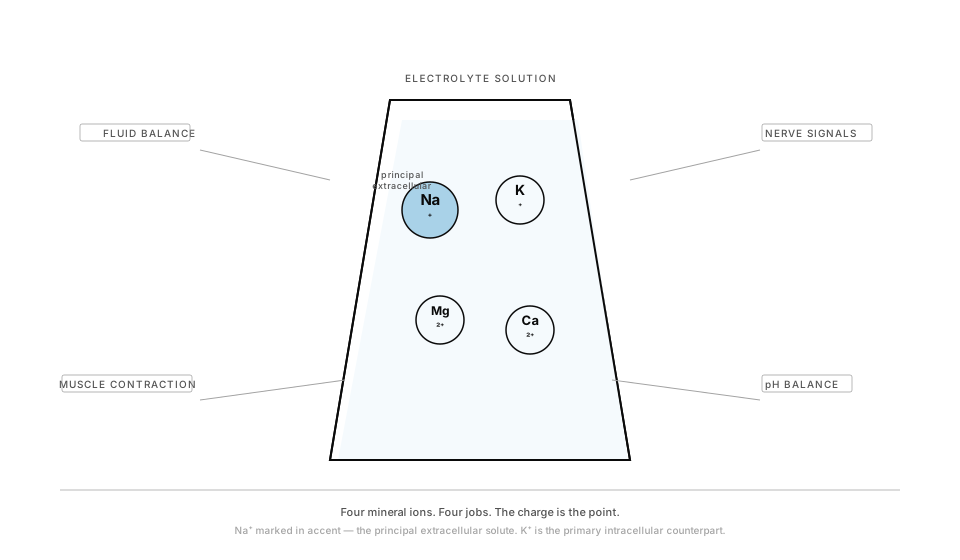
The four jobs
These five ions are responsible for four distinct physiological tasks. They are not wellness additions. They are operating infrastructure.
Fluid balance
Water follows solutes. Sodium sits primarily outside cells; potassium sits primarily inside. The difference in their concentrations across cell membranes creates the osmotic gradients that determine where water goes — how much fluid stays in blood vessels, how much enters cells, how much your kidneys retain or excrete. Electrolytes do not just “hydrate you.” They determine where water distributes throughout every compartment in the body. A deep explanation of this mechanism is in Fluid balance 101.
Nerve signaling
Every nerve impulse is a controlled movement of ions across a membrane. At rest, sodium is kept outside the nerve cell and potassium is kept inside, creating a voltage difference (the resting membrane potential, around −70 mV). When a signal arrives, sodium rushes in — the cell depolarizes, generating an action potential. Then potassium rushes out to restore the resting state. The sodium-potassium pump (Na+/K+-ATPase) runs continuously to rebuild those gradients so the next signal can fire. No electrolytes, no nerve conduction.
Muscle contraction
Muscle contraction begins as a nerve signal — so electrolytes are already involved before the muscle fires. When the signal reaches the muscle fiber, it triggers calcium release from an internal store (the sarcoplasmic reticulum). Calcium binds to a protein called troponin, which exposes the binding sites on actin that myosin can grab. The grab is the contraction. Magnesium is needed for muscle relaxation — it competes with calcium at these binding sites and enables the fiber to let go. Without calcium to trigger and magnesium to release, muscles neither contract nor relax correctly.
Acid-base balance (pH)
The body holds blood pH in a tight range — roughly 7.35 to 7.45 — and electrolytes are part of the system that holds it there. Chloride and bicarbonate shift between blood and red blood cells as carbon dioxide is transported. Phosphate acts as a buffer in intracellular fluid. The kidneys adjust the excretion of acids and bases in part by regulating sodium and chloride reabsorption. A sustained imbalance in electrolytes can tip the blood outside its normal pH range, with consequences for nearly every enzyme in the body.
5
primary electrolytes: Na+, K+, Mg2+, Ca2+, Cl−
−70 mV
approximate resting membrane potential in nerve cells — the voltage electrolytes maintain
600+
enzymatic reactions that use magnesium as a cofactor
Why balance matters more than amount
The question is not only whether you have enough of each electrolyte. It is whether the ratios between them are maintained.
Sodium and potassium work as a pair. Sodium drives into cells during nerve depolarization; potassium drives out during repolarization. The Na+/K+-ATPase pump restores both, spending one ATP to move three sodium ions out and two potassium ions in on every cycle. That constant exchange is why the ratio of sodium to potassium in the diet matters — not just the absolute amount of either.
Calcium and magnesium work as another pair, in muscle and beyond. Calcium triggers; magnesium tempers. A surplus of one without the other distorts the system. This is why simply adding calcium to a formula without considering magnesium is not a neutral act.
Fluid balance adds a third dimension. Sodium draws water toward itself, and excessive sodium without adequate potassium can skew how fluid distributes between intracellular and extracellular space. The body manages this with hormones — aldosterone to retain sodium, ADH to retain water, natriuretic peptides to release both — but those hormones are working against the composition you provide, or with it.
The internal environment of the body is held remarkably constant — a constancy achieved by the continuous interplay of electrolytes, hormones, and the kidney.— The principle of homeostasis, as developed in Guyton and Hall, Textbook of Medical Physiology
Where you lose them, and why replacement matters
The body has no large reserves of sodium, potassium, or magnesium. What it holds, it holds in active use — and what it loses, it loses continuously.
Sweat
- The primary electrolyte in sweat is sodium. Sweat sodium concentration varies widely between individuals — roughly 10 to 90 mmol/L (about 230 to 2,070 mg per liter), with typical athlete values clustering near 40–50 mmol/L (roughly 900 to 1,150 mg/L).
- Potassium, magnesium, and calcium are present in sweat, but in smaller amounts than sodium.
- Heavy or prolonged sweating (exercise, heat, illness) represents a meaningful loss that plain water does not replace.
Urine
- The kidneys are the principal regulator of electrolyte balance. When sodium is plentiful, the kidneys excrete more. When sodium is low, they retain nearly all of it.
- Potassium is excreted readily; unlike sodium, the kidney has a limited ability to conserve potassium at very low intakes.
- Magnesium is excreted continuously, and excretion rises after alcohol consumption and with certain medications.
The practical consequence is that maintaining electrolyte balance requires continuous dietary intake, not a one-time dose. Most people are not acutely deficient day to day — a varied diet provides enough for baseline needs. The pressure mounts at the margins: in heat, in sustained exercise, in illness involving vomiting or diarrhea, or in any situation that concentrates losses over time.
Drinking plain water in these situations replaces fluid volume without replacing the solutes that were lost with it. The result is a dilution of the remaining electrolytes; when blood sodium falls below its normal range, the condition is called hyponatremia, and in the endurance context specifically it is termed exercise-associated hyponatremia. A diluted electrolyte balance can impair the very functions electrolytes were needed for. The point of an electrolyte product is to replace what was lost, not to add something exotic.
Sweat sodium concentration varies roughly tenfold between individuals. The range — approximately 10 to 90 mmol/L, or about 230 to 2,070 mg per liter — means that two people doing the same workout lose dramatically different amounts of sodium. This is why individual variation in electrolyte needs is real, not a marketing abstraction.
This statement has not been evaluated by the Food and Drug Administration. This product is not intended to diagnose, treat, cure, or prevent any disease.
Sources
- Hall JE, Hall ME. Guyton and Hall Textbook of Medical Physiology — electrolyte physiology, membrane potentials, and fluid compartments.
- U.S. National Institutes of Health, Office of Dietary Supplements — fact sheets for sodium, potassium, magnesium, and calcium. ods.od.nih.gov.
- Linus Pauling Institute, Oregon State University — electrolyte and mineral overviews. lpi.oregonstate.edu/mic.
- U.S. FDA — Daily Values for nutrients established in the 2016 Nutrition Facts label rule: sodium 2,300 mg; potassium 4,700 mg; magnesium 420 mg; calcium 1,300 mg. fda.gov.
The charge is the point
Every electrolyte in this product is here because it has a job. The science hub maps the rest of the picture.