Foundations
Fluid balance 101: how your body moves water
Water has no pump of its own. It moves because solutes pull it. Sodium is the principal solute outside your cells, so sodium is the primary determinant of where water goes in your body. Two hormones and a pair of kidneys work constantly to keep the balance right. This is the system — and electrolytes are not a supplement to it. They are what it runs on.
Water follows solutes
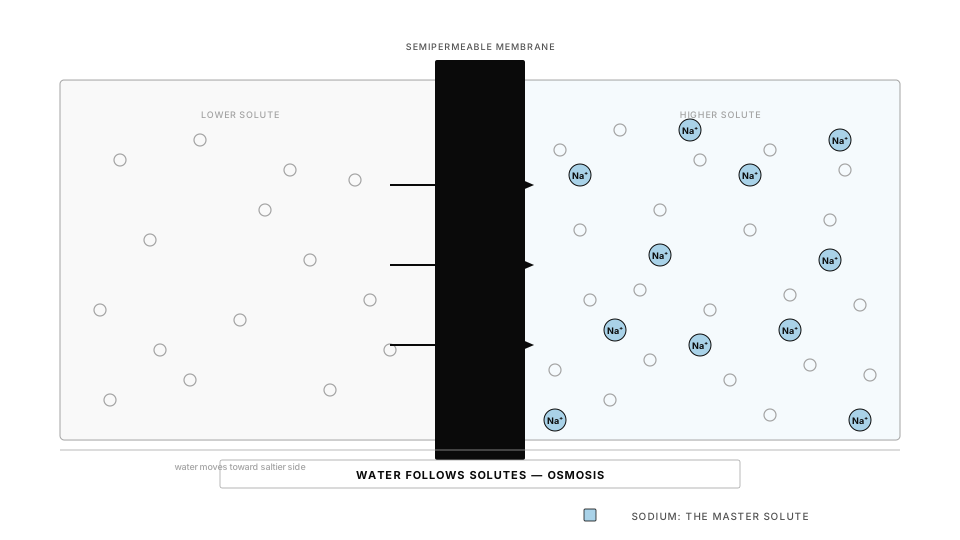
Osmosis is the name for one of the most consequential tendencies in biology: when two compartments are separated by a membrane that water can cross but solutes cannot, water moves toward the saltier side until the concentrations equalize.
The direction is always toward higher solute concentration. There is no active energy expenditure in this step — water diffuses passively down its own concentration gradient (which, because water occupies the space that solutes do not, is the mirror image of the solute gradient). Put differently: the saltier a compartment is, the more powerfully it draws water toward it.
The force driving this movement is called osmotic pressure. A solution with a higher solute concentration exerts higher osmotic pressure, and water moves from low-pressure to high-pressure compartments until the pressures equalize. The body uses this passive tendency as a distribution mechanism, and electrolytes are the primary tool for setting the pressure in each compartment.
The osmolality of blood plasma — the concentration of dissolved particles per kilogram of water, the figure clinical labs actually measure — is maintained in a narrow range, roughly 275 to 295 milliosmoles per kilogram (mOsm/kg). Deviations of even a few percent trigger hormonal responses. Sodium and its associated anions account for more than 90% of extracellular osmolality, which is why sodium is so often called the master solute of the extracellular space.
Sodium outside, potassium inside
The body is organized around one fundamental asymmetry: sodium dominates outside cells, and potassium dominates inside. That separation is not accidental. It is actively maintained, at continuous energy cost, because it is the foundation of almost everything else.
Extracellular fluid — sodium
- Normal plasma sodium concentration: approximately 135–145 mmol/L.
- Sodium is the primary osmotically active solute in blood and interstitial fluid — the fluid that bathes cells.
- Because sodium governs extracellular osmolality, it governs blood volume. More sodium in the extracellular space draws water into it; less sodium allows water to leave.
- The kidneys regulate sodium retention and excretion as the primary handle on blood volume and blood pressure.
Intracellular fluid — potassium
- Normal intracellular potassium concentration: approximately 120–150 mmol/L — roughly 30 times higher than in plasma.
- Potassium is the primary osmotically active solute inside cells. It holds cell volume.
- The steep potassium gradient across the cell membrane (inside high, outside low) is the main contributor to the resting membrane potential that nerve and muscle cells need to function.
- The Na+/K+-ATPase pump moves three sodium ions out and two potassium ions in per ATP, actively maintaining the gradient.
This is why the sodium-potassium pair cannot be understood separately. They are the two sides of the same charge: sodium pulling water into the extracellular space, potassium holding water inside cells. An imbalance in either direction — too little potassium, too much sodium, or vice versa — distorts cell volume, nerve conduction, and blood pressure simultaneously.
90%
of extracellular osmolality accounted for by sodium and its anions
30×
higher potassium concentration inside cells than in plasma
3:2
Na+ pumped out for every K+ pumped in by the Na+/K+-ATPase
How the body holds the balance
The body does not passively accept whatever electrolytes and fluid you provide. It runs a continuous correction system: sensors measure osmolality and volume, hormones adjust retention and loss, and the kidneys execute the adjustments in urine. The steps below describe that loop.
Thirst
The hypothalamus contains osmoreceptors — cells sensitive to the osmolality of the blood flowing past them, concentrated in structures at the front of the hypothalamus that sit outside the blood-brain barrier. When osmolality rises (blood becomes more concentrated, typically from fluid loss or sodium intake), these cells signal thirst. Thirst is a comparatively late signal; by the time it is perceptible, blood osmolality has typically already risen one to three percent above baseline. Waiting to drink until thirsty during exercise in heat is a reliable route to underhydration.
ADH / vasopressin — water retention
The same hypothalamic sensors that trigger thirst also stimulate the release of antidiuretic hormone (ADH, also called vasopressin) from the posterior pituitary. ADH acts on the kidneys, instructing the collecting ducts to insert water channels (aquaporins) into their walls, so more water is reabsorbed from urine back into the bloodstream. The result is concentrated urine and a return of blood osmolality toward normal. When osmolality is low, ADH is suppressed and dilute urine is excreted. ADH is a water-handling hormone, not a sodium-handling one.
Aldosterone — sodium retention
If blood volume falls (from hemorrhage, severe sweating, or dehydration), the kidneys detect reduced pressure in their arterioles and release renin. Renin triggers a cascade that ends in the production of aldosterone from the adrenal glands. Aldosterone acts on the kidney tubules to retain sodium — and water follows the sodium, restoring blood volume. Aldosterone is a sodium-and-volume hormone. The reason the system is layered this way (ADH for osmolality, aldosterone for volume) is that the body needs to regulate both independently: you can be adequately hydrated but sodium-depleted, or fluid-overloaded but still losing sodium in sweat.
The kidneys as the final executor
The kidneys filter on the order of 150 to 180 liters of fluid per day — about 180 in a typical adult male, somewhat less in a typical adult female — and reabsorb nearly all of it, so the final volume of urine is usually 1–2 liters. This high-throughput filtration-and-selective-reabsorption process is how the body actually moves electrolytes: almost every electrolyte in the body passes through the kidney multiple times per day, and the amount retained depends on hormonal signals. The kidneys can adjust sodium excretion across more than a hundredfold range, from a few millimoles per day in sodium-depleted states to several hundred millimoles in sodium excess.
Water balance is not simply a matter of how much you drink. It is the result of a precisely tuned interplay between osmolality sensors, hormonal signals, and renal adjustment that operates continuously, whether you are aware of it or not.— The integrated view of osmoregulation, after Verbalis JG, Best Practice & Research Clinical Endocrinology & Metabolism, 2003
Electrolytes are the system. Water is what flows through it.
The phrase “stay hydrated” is almost always understood to mean “drink more water.” The physiology says something more precise: water will distribute where solutes pull it. Drinking water raises the fluid volume you take in, but the distribution of that fluid — how much stays in blood, how much enters cells, how much the kidneys retain — is determined by the electrolyte concentrations in each compartment.
This has two practical implications. First, drinking large amounts of plain water during heavy sweating can dilute extracellular sodium faster than the kidneys can compensate, pulling water into cells and reducing blood volume — a condition called hyponatremia that can range from headache to dangerous neurological effects. The kidneys can excrete excess water quickly, but they cannot make sodium from scratch.
Second, the argument for electrolytes in a drink is not that they “help you absorb water.” It is more fundamental: they are the solutes that determine where water goes once it is absorbed. Sodium in the gut stimulates cotransport mechanisms that move both sodium and water across the intestinal wall efficiently (the subject of sodium-glucose cotransport); sodium in the blood holds water in the vascular space; sodium in the interstitium keeps fluid from shifting into cells inappropriately.
Electrolytes are not an addition to hydration. They are the system that hydration runs on.
This statement has not been evaluated by the Food and Drug Administration. This product is not intended to diagnose, treat, cure, or prevent any disease.
Sources
- Hall JE, Hall ME. Guyton and Hall Textbook of Medical Physiology — body-fluid compartments, osmosis, and renal regulation of electrolytes and water.
- Verbalis JG. Disorders of body water homeostasis. Best Practice & Research Clinical Endocrinology & Metabolism 17(4):471–503, 2003 — osmoregulation, ADH, and the integrated control of tonicity. doi:10.1016/s1521-690x(03)00049-6
- Baker LB. Sweating rate and sweat sodium concentration in athletes: a review of methodology and intra/interindividual variability. Sports Medicine 47(Suppl 1):111–128, 2017 — sweat as a fluid-balance stressor, and the wide inter-individual range in sweat sodium. doi:10.1007/s40279-017-0691-5
The system, in a glass
Water follows sodium. We dose to the mechanism. The science hub maps the rest.