Foundations
Why potassium, and why most people are short
Sodium gets the attention in nutrition conversations because it is the one most Americans consume too much of. Potassium is the one most Americans consume too little of. The two are not unrelated: they are partners in the most fundamental ion balance in biology, operating on opposite sides of the same cell membrane, and the ratio between them matters in ways that go beyond either mineral alone.
Sodium outside, potassium inside
At the most basic level of cell biology, sodium and potassium are mirror-image players. Sodium is concentrated outside cells; potassium is concentrated inside. Both gradients are maintained by the same protein — the sodium-potassium pump, a membrane ATPase that pushes three sodium ions out for every two potassium ions it brings in, spending one ATP per cycle.
The numbers illustrate the asymmetry. Sodium sits at roughly 140 millimolar in the extracellular fluid and around 12 millimolar inside cells. Potassium is inverted: about 140 millimolar inside cells, 4 millimolar outside. These gradients are not incidental. They are the medium in which every action potential propagates, every muscle contraction initiates, and every secondary active transport event — including glucose absorption across the gut — operates.
This is why potassium cannot be reduced to a single function or a single claim. It is a structural component of how cells are electrically organized. Replacing the potassium lost in sweat or urine is not supplementation in the marketing sense. It is maintenance of a system the body runs continuously at significant energetic cost. More on that system: the sodium-potassium pump.
Sodium — mostly outside cells
- Extracellular concentration ~140 mM; intracellular ~12 mM.
- Drives electrical excitability: Na⁺ rushes in on depolarization.
- Powers secondary active transport (SGLT1, amino acid transporters).
- U.S. typical intake: well above recommended in most adults.
Potassium — mostly inside cells
- Intracellular concentration ~140 mM; extracellular ~4 mM.
- Sets and restores resting membrane potential after each firing.
- Required for the pump to function: K⁺ binds from outside to complete each cycle.
- U.S. typical intake: well below recommended in most adults.
What potassium does to the effect of sodium
The most studied population-level consequence of potassium intake is its relationship with blood pressure — specifically, its tendency to blunt the blood-pressure-raising effect of sodium. The evidence is substantial and consistent enough to have shaped major dietary guidelines.
A 2013 systematic review and meta-analysis published in the BMJ (Aburto and colleagues), commissioned as part of the WHO’s guideline work, pooled controlled trials of increased potassium intake in adults. It found that higher potassium intake was associated with reduced systolic and diastolic blood pressure, with the effect concentrated in adults who already had hypertension and most pronounced in people consuming relatively high amounts of sodium; the review reported no adverse effect on kidney function or blood lipids in healthy adults. The mechanism appears to involve increased urinary sodium excretion: higher potassium intake can shift the kidney’s handling of sodium in ways that lower the net sodium load the vasculature sees.
This is the physiological underpinning of the DASH diet’s emphasis on fruits and vegetables — foods that happen to be high in potassium — alongside its sodium limits. The sodium-potassium ratio in the diet, not just the absolute amount of either one, appears to matter for vascular outcomes in populations with typical Western dietary patterns.
A note on precision: this is population-level nutritional epidemiology and controlled trial data, not a claim about any individual’s blood pressure or any particular health outcome. The relationship is real and well-supported; the direction of causation in intervention studies is as consistent as this literature gets. What it does not do is license a claim that any product treats or prevents hypertension or cardiovascular disease.
This statement has not been evaluated by the Food and Drug Administration. This product is not intended to diagnose, treat, cure, or prevent any disease.
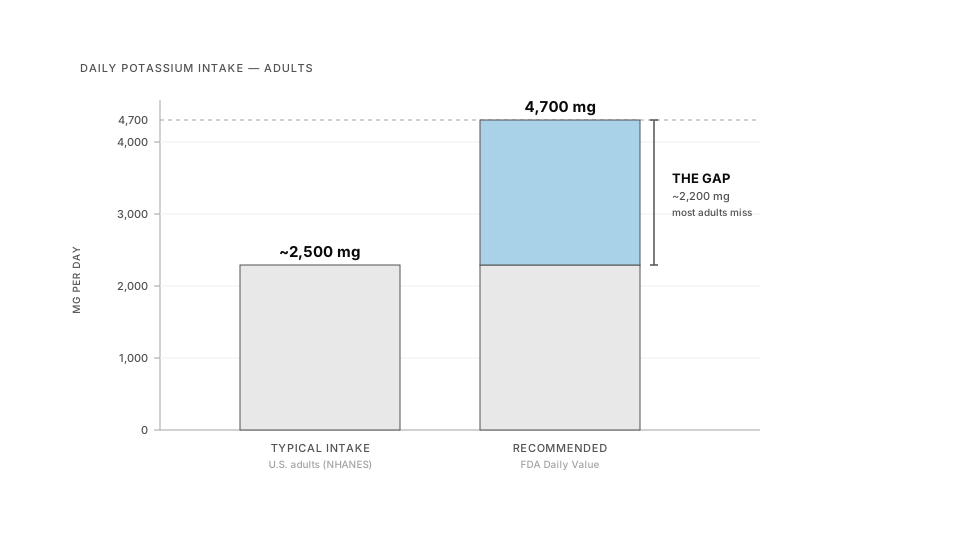
Most people are short, and by a lot
4,700 mg
the FDA Daily Value for potassium, the reference used on the Nutrition Facts label (21 CFR 101.9)
~2,300–3,000 mg
average daily potassium intake from food for U.S. adults — about 2,320 mg for women and 3,016 mg for men (NHANES, via NIH ODS)
most
adults fall below the recommended intake — potassium is flagged as a nutrient of public health concern in the Dietary Guidelines for Americans
Two reference numbers are worth keeping straight, because they differ. The FDA’s Daily Value for potassium — the figure on the Nutrition Facts label — is 4,700 milligrams per day. The National Academies’ 2019 Dietary Reference Intakes set a lower Adequate Intake: 3,400 milligrams for adult men and 2,600 milligrams for adult women, a downward revision from the older 4,700 mg figure. By either yardstick, most U.S. adults come up short. NHANES survey data put average intake from food at about 3,016 milligrams a day for men and 2,320 milligrams for women — under the label Daily Value across the board, and below the current AI for a large share of adults.
This is not a marginal miss, and it is consistent enough that the Dietary Guidelines for Americans name potassium a nutrient of public health concern — one Americans under-consume as a population. It reflects a dietary pattern built around processed food, which tends to be high in sodium and low in potassium — the inverse of the cellular gradient the body needs to maintain.
For people who sweat at meaningful rates — athletes, those working outdoors, anyone in heat — the baseline shortfall compounds. Sweat carries potassium, typically on the order of 150 to 390 milligrams per liter (roughly 4 to 10 millimoles), depending on the individual and conditions. A long session in the heat can add a few hundred milligrams of loss on top of an intake that was already short. Starting low and losing more is not a neutral baseline.
Meaningful dose, clean form
Potassium appears in many electrolyte products — but often in token amounts, or in forms chosen for cost rather than tolerance or metabolic profile. The decisions in our formula are deliberate.
We use potassium citrate. Citrate is a common organic anion form used in both food and pharmaceutical contexts. It tends to be well tolerated in the GI tract at the doses used in electrolyte products, and citrate as an anion is metabolized to bicarbonate — mildly alkalizing, which can be relevant in contexts where metabolic acid load is elevated, as it often is during sustained exercise. It is not chloride (the form in many electrolyte salts), which matters for people who are trying to replace the mineral without adding substantially to chloride load.
The dose is set at a meaningful level: enough to move the needle toward the AI in the context of an athletic or active day, not a token amount chosen to print “potassium” on the label. We do not claim it resolves a deficiency, closes the intake gap on its own, or produces any specific health outcome — those are not our claims to make. What we do say is that potassium is in the formula because the physiology of cells requires it, because most people are chronically short of it, and because a complete electrolyte without it is missing a foundational piece.
Sources
- National Academies of Sciences, Engineering, and Medicine. Dietary Reference Intakes for Sodium and Potassium. Washington, DC: The National Academies Press, 2019. doi:10.17226/25353 — the 2019 Adequate Intakes for potassium (3,400 mg/day for adult men, 2,600 mg/day for adult women), a downward revision from the 2005 value of 4,700 mg/day.
- U.S. Food and Drug Administration. Daily Value for potassium (4,700 mg) per 21 CFR 101.9 — the reference value on the Nutrition Facts label.
- National Institutes of Health, Office of Dietary Supplements. Potassium — Fact Sheet for Health Professionals. — intake reference values and U.S. average intakes from NHANES (about 3,016 mg/day for men and 2,320 mg/day for women, adults 20+).
- U.S. Department of Agriculture & U.S. Department of Health and Human Services. Dietary Guidelines for Americans — potassium identified as a nutrient of public health concern, under-consumed across the U.S. population.
- Aburto NJ, Hanson S, Gutierrez H, Hooper L, Elliott P, Cappuccio FP. Effect of increased potassium intake on cardiovascular risk factors and disease: systematic review and meta-analyses. BMJ 346:f1378, 2013. doi:10.1136/bmj.f1378 — increased potassium intake associated with lower blood pressure, with a larger effect at higher sodium intakes.
Both sides of the membrane
Sodium and potassium work as a pair. The formula accounts for both. The science hub maps the rest of the picture.