The problem
Hyponatremia: when hydration goes too far
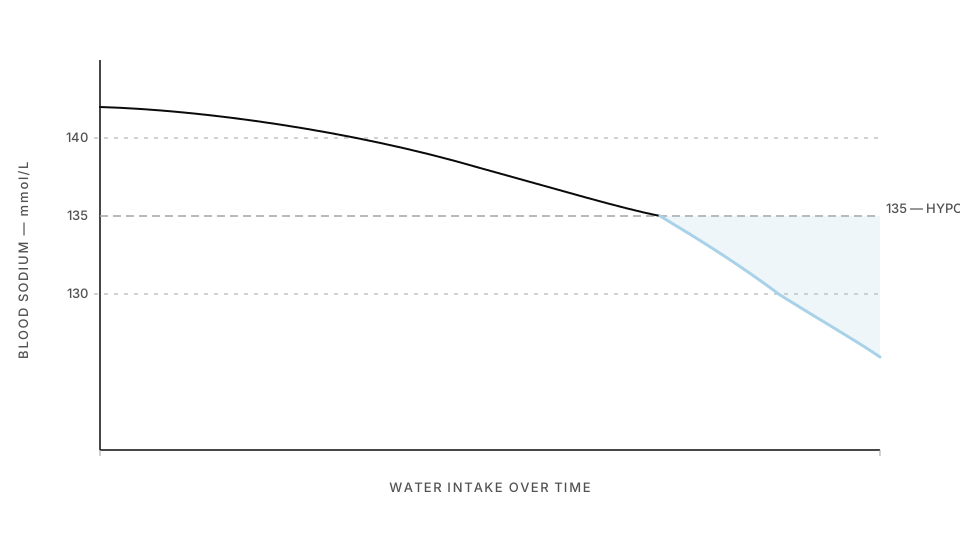
Blood sodium falls when you drink more water than your kidneys can clear. Below 135 mmol/L it has a name — hyponatremia — and in its severe form it becomes a medical emergency. The research consensus is that drinking volume, not sodium loss, is the primary driver. That reframes what good hydration actually means.
You can drink too much water
Most people who think about exercise and hydration worry about drinking too little. The premise has been drilled in for decades: dehydration impairs performance, heat illness follows, drink before you are thirsty. That is not wrong, as far as it goes. But it is incomplete in a way that has hospitalized — and in rare cases killed — endurance athletes who took the advice too seriously.
The condition that results from drinking too much was first described in the medical literature as “water intoxication.” The named clinical version is hyponatremia, and the exercise-associated form — EAH — is well documented at screened events ranging from road marathons to ultramarathons to military training.
The point is not that water is dangerous. It is that your body defends concentration, not volume, and that distinction matters more than most hydration messaging has acknowledged.
- Hyponatremia
- Serum sodium below 135 millimoles per liter (mmol/L). The normal range sits between roughly 135 and 145 mmol/L. At the severe end — typically below 120 mmol/L — symptoms can include seizures, cerebral edema, and respiratory arrest.
- EAH — exercise-associated hyponatremia
- The same condition arising during or within 24 hours of sustained physical activity. The mechanism is the same; the context is an event or training session that provides sustained access to fluid and a reason to drink past thirst.
Four moves that lower blood sodium
The 2015 Third International EAH Consensus Statement describes the mechanism in four linked steps. Sodium loss matters at the margin, but the primary driver is volume.
Overdrink hypotonic fluid
Any fluid with a lower sodium concentration than plasma — plain water, and most commercial sports drinks — dilutes the sodium already in the bloodstream when taken in large volume. The more hypotonic the fluid and the greater the volume, the steeper the dilution.
Kidneys can’t clear it fast enough
The healthy kidney can excrete free water, but not without limit. Maximum renal free water clearance is roughly 0.8–1.0 L/hour under typical conditions. An athlete drinking at a rate above that, across several hours, accumulates a water surplus the kidneys cannot resolve in real time.
Non-osmotic vasopressin holds water in
Exercise, nausea, pain, and emotional stress all trigger release of vasopressin (antidiuretic hormone) through pathways that do not depend on blood osmolality. This non-osmotic release tells the kidneys to retain water even when serum sodium has already dropped — compounding the overdrink rather than correcting it.
Blood sodium falls below 135 mmol/L
The accumulated excess water lowers the concentration of sodium in the blood. The further it falls, and the faster, the more serious the outcome. The 2015 consensus is direct: final blood sodium is determined primarily by fluid intake volume, not by sodium losses in sweat.
Sodium intake can attenuate the dilution — it raises the osmolality of what you drink and reduces the diluting effect per unit volume — but the consensus is clear that you cannot drink freely and supplement your way out of the volume problem. Sodium matters at the margin; volume is the primary variable.
135 mmol/L
serum sodium threshold — below this is hyponatremia (Hew-Butler et al., 2015)
5–51%
range of mostly asymptomatic EAH found when athletes are screened at endurance events; symptomatic cases are far rarer, about 0.1–1.0% (Exercise-Associated Hyponatremia, StatPearls)
Volume
primary driver of final blood sodium — not sodium loss in sweat (2015 Consensus Statement)
Not just elite athletes
Early attention focused on competitive distance runners. The profile has since broadened as more events have been screened. Marathoners are well represented in the literature, but so are hikers on long-distance trails, military personnel in sustained training, and team-sport athletes during multi-day camps with unlimited fluid access and social pressure to drink.
The common thread is not athletic level. It is sustained duration and unrestricted access to fluid. Slower athletes at long events — those on course for five, six, seven hours — carry particular risk because they have more time to accumulate excess fluid, and because they are more likely to be following a “drink often, drink early” regimen marketed for shorter, higher-intensity efforts.
Body weight gain during a race is a reliable field signal: if you weigh more at the finish than at the start, you have drunk more than you excreted. EAH nearly always involves some degree of weight gain over the event. Weight loss, by contrast, is normal and expected — sweat, respiratory water vapor, and substrate oxidation all reduce mass.
The Third International EAH Consensus Development Conference was convened in 2015 specifically because the condition was being under-recognized at events that already had medical support in place. The researchers concluded the field needed a clearer statement that volume — not sodium depletion — is the primary variable.
Drink to thirst — think in concentration
The practical upshot of the EAH research is a shift in framing. The question is not simply “am I drinking enough?” It is “what is the concentration of what I am drinking, and how much total volume am I taking in?” Thirst, when it is functioning normally, is a reasonable guide — it exists precisely to signal need before a deficit becomes harmful. Overriding it with scheduled drinking, at volumes calibrated for a faster athlete or a hotter day than yours, is how the math goes wrong.
Sodium intake is not irrelevant. It raises the osmolality of what you drink, reduces the diluting effect on blood sodium, and can help sustain thirst so you do not overshoot. But it is not a license to drink freely. The concentration of what you drink and the total volume you drink are both part of the picture. The research is unambiguous that managing volume is the more powerful lever.
The individual piece of this — the fact that some people lose far more sodium per liter of sweat than others — is a separate but connected story. That variability is real, well documented, and relevant to how much sodium belongs in a drink tailored to you rather than to a population average. The salty-sweater article takes that up directly.
This statement has not been evaluated by the Food and Drug Administration. This product is not intended to diagnose, treat, cure, or prevent any disease.
Sources
- Hew-Butler T, Rosner MH, Fowkes-Godek S, et al. Statement of the Third International Exercise-Associated Hyponatremia Consensus Development Conference, Carlsbad, California, 2015. Clinical Journal of Sport Medicine 25(4):303–320, 2015. doi:10.1097/JSM.0000000000000221
- Noakes TD, Goodwin N, Rayner BL, Branken T, Taylor RKN. Water intoxication: a possible complication during endurance exercise. Medicine & Science in Sports & Exercise 17(3):370–375, 1985. PMID 4021781.
- Rosner MH, Kirven J. Exercise-associated hyponatremia. Clinical Journal of the American Society of Nephrology 2(1):151–161, 2007 (review). doi:10.2215/CJN.02730806
- Buck E, McAllister R, Schroeder JD. Exercise-Associated Hyponatremia. In: StatPearls. Treasure Island (FL): StatPearls Publishing; updated 2023. NCBI Bookshelf NBK572128, PMID 34283494.
Concentration over volume
The science hub maps the full picture — from the mechanism of sodium absorption to the variability in what you lose.