Foundations
The sodium-potassium pump: the engine under everything
Every nerve impulse you have ever felt, every contraction your muscles have ever made, and every molecule of sodium your gut has ever absorbed across its wall — all of them depend on a gradient that a single protein builds and maintains, continuously, at the cost of a meaningful share of everything you eat. That protein is the sodium-potassium pump. It was discovered in 1957 by a Danish physiologist working on crab nerve, and it has not stopped running since.
A crab nerve and an enzyme no one expected
In the mid-1950s, Jens Christian Skou was studying the effects of local anesthetics on crab nerve when he noticed something he had not been looking for: an enzyme in the nerve membrane that broke down ATP — and did so in a way that depended, peculiarly, on both sodium and potassium being present.
Skou published his finding in 1957 in Biochimica et Biophysica Acta. He had not set out to find the mechanism of the sodium-potassium gradient, but he had found it anyway. The enzyme he described — now called the Na,K-ATPase — was the pump that physiologists had suspected must exist but had not been able to identify: the machine that actively moves sodium out of cells and potassium in, against their respective concentration gradients, and does so by consuming adenosine triphosphate one molecule at a time.
The field took a few years to recognize what it had. By the 1960s the case was clear, and the Na,K-ATPase had moved from observation to established mechanism. Forty years after the paper, Skou was awarded one half of the 1997 Nobel Prize in Chemistry “for the first discovery of an ion-transporting enzyme, Na⁺,K⁺-ATPase.” The other half went jointly to Paul Boyer and John Walker for their work on the enzyme that synthesizes ATP. It was the first Nobel recognizing a membrane ion-transport protein.
1957
Skou describes the Na,K-ATPase in crab peripheral nerve. Nobel Prize follows in 1997 — a forty-year arc from curious observation to canonical mechanism.
Five moves, one ATP, one cycle
The pump is a conformational machine: it physically changes shape to move ions across the membrane. The cycle has been worked out in fine structural detail. These are the steps.
Three sodium ions bind inside
The pump opens its binding sites toward the cytoplasm. Three sodium ions, present in high concentration inside the cell (or rather: trying to accumulate there from prior cycles not yet corrected), bind within the protein’s ion-binding pocket.
ATP phosphorylates the pump
With sodium aboard, the pump cleaves one molecule of ATP. The phosphate group transfers to the pump protein itself, locking in energy and driving a conformational change that closes the intracellular face and opens the extracellular one.
Three sodium ions exit
The binding pocket, now facing outward, has lower affinity for sodium in this conformation. The three sodium ions release into the extracellular space, where sodium is already high — against the gradient. That uphill movement is what the ATP paid for.
Two potassium ions bind outside
The outward-facing pocket binds two potassium ions from the extracellular fluid, where potassium is abundant. The phosphate group releases from the pump, allowing another conformational change back toward the intracellular face.
Two potassium ions enter
The inward-facing pocket has low affinity for potassium, so both ions release into the cytoplasm. The pump is now in its original conformation, ready to bind three more sodium ions. The cycle repeats, continuously, as long as ATP is available.
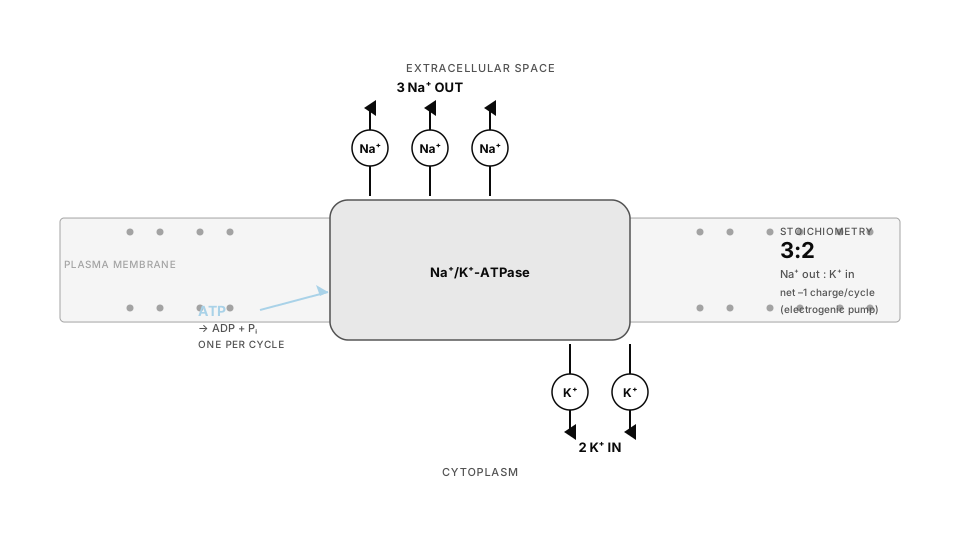
The net result of each cycle: three sodium ions leave the cell, two potassium ions enter, and one ATP is consumed. Because more positive charge exits than enters, the pump is electrogenic — it contributes a small direct hyperpolarizing current to the membrane potential in addition to building the gradients that do it indirectly through ion diffusion.
What the gradient costs to maintain
~1/5 of RMR
roughly a fifth of whole-body resting energy expenditure is estimated to go to Na,K-ATPase activity — on the order of 19–28% of the ATP the body turns over at rest (Rolfe & Brown, Physiological Reviews 1997)
3:2
sodium out to potassium in, per ATP — the fixed stoichiometry of the pump
~140 mM
sodium concentration outside the cell vs. ~12 mM inside — the gradient the pump maintains
Estimates of how much of the body’s resting energy goes to running Na,K-ATPase pumps cluster around a fifth — Rolfe and Brown’s 1997 accounting of mammalian resting metabolism put the pump at roughly 19 to 28 percent of the ATP turned over at rest. The share is higher still in electrically active tissue: in the brain, the sodium-potassium pump is commonly estimated to consume around half of all ATP used. However it is counted, this is not a rounding error. It is one of the largest single items in the body’s energy budget, and it reflects how essential the gradient is and how much continuous work it takes to hold it.
The gradient the pump maintains is steep: sodium sits at roughly 140 millimolar outside the cell and 12 inside; potassium at around 4 mM outside and 140 inside. Every time a nerve fires, or a muscle contracts, or the gut cotransporter SGLT1 moves a molecule of glucose, that stored gradient is spent — and the pump immediately begins rebuilding it. The pump never gets to stop.
The gradient is the currency
The pump does not directly do most of what cells need to do. It builds the gradient, and the gradient does everything else. Three broad categories depend on it directly.
- Membrane potential and electrical excitability
- The sodium and potassium gradients, together with selective membrane permeability, set the resting membrane potential of cells — around −70 millivolts in a typical neuron. That voltage is the loaded spring that action potentials draw on. When a nerve fires, sodium rushes in down its gradient, flipping the potential; the pump restores the gradient between firings.
- Muscle contraction
- Skeletal, cardiac, and smooth muscle all initiate contraction via action potentials that depend on the same sodium and potassium gradients. The pump’s activity is not a background detail for muscle function — it is its precondition. Sustained exercise, which raises intracellular sodium, also upregulates pump activity to keep pace.
- Secondary active transport
- Many of the body’s most important transport processes — including the absorption of glucose and amino acids across the gut — are powered not by ATP directly but by the sodium gradient the pump builds. The sodium-glucose cotransporter SGLT1 in the intestinal lining is a direct example: it uses the low intracellular sodium concentration (maintained by the pump) as the driving force to pull glucose uphill across the gut wall. The pump is the upstream energy source for sodium-glucose cotransport.
This is why electrolyte balance is not just about thirst or cramps. Sodium and potassium are the substrates of a system the body runs at considerable expense. Keeping them available — replacing what is lost in sweat, maintaining their concentrations on either side of cell membranes — is the material support for a biological infrastructure that runs every moment of waking and sleeping life.
This statement has not been evaluated by the Food and Drug Administration. This product is not intended to diagnose, treat, cure, or prevent any disease.
“For the first discovery of an ion-transporting enzyme, Na⁺,K⁺-ATPase.”— The Royal Swedish Academy of Sciences, award citation for the 1997 Nobel Prize in Chemistry (one half, to Jens C. Skou)
Sources
- Skou JC. The influence of some cations on an adenosine triphosphatase from peripheral nerves. Biochimica et Biophysica Acta 23:394–401, 1957. doi:10.1016/0006-3002(57)90343-8 — the discovery of the Na,K-ATPase.
- The Nobel Prize in Chemistry 1997. The Royal Swedish Academy of Sciences — awarded one half to Jens C. Skou “for the first discovery of an ion-transporting enzyme, Na⁺,K⁺-ATPase,” with the other half jointly to Paul D. Boyer and John E. Walker for the mechanism of ATP synthesis.
- Clausen MV, Hilbers F, Poulsen H. The structure and function of the Na,K-ATPase isoforms in health and disease. Frontiers in Physiology 8:371, 2017. doi:10.3389/fphys.2017.00371 — stoichiometry (3 Na⁺:2 K⁺), isoforms, and structural mechanism.
- Rolfe DFS, Brown GC. Cellular energy utilization and molecular origin of standard metabolic rate in mammals. Physiological Reviews 77(3):731–758, 1997. doi:10.1152/physrev.1997.77.3.731 — whole-body energy budget; Na,K-ATPase as roughly a fifth of resting ATP turnover.
The pump runs everything
Sodium and potassium are in the formula because the pump that moves them is in every cell. The science hub maps the rest of the picture.