Purity & safety
Ingredient grade & sourcing: where purity starts
Purity is not a property you add at the end of a supply chain. It is largely a property of what you chose to buy at the beginning. Grade and origin are the first decisions in any supplement formula, and they shape everything downstream — including what a third-party test can and cannot catch.
Not all ingredients are equal — by design
The supplement industry draws on three tiers of ingredient quality. They are not synonyms. Each tier is defined by the purity tolerances it must meet, the testing that backs those tolerances, and the bodies that set the standards.
Grade classification is a specification system, not a brand claim. USP stands for the United States Pharmacopeia, an independent standards organization that publishes legally enforceable monographs for drugs and, increasingly, dietary supplements. Food-grade is the regulated minimum for human consumption under FDA oversight. Technical-grade was designed for industrial processes and was never intended for ingestion. The three categories exist because different applications require different purity ceilings, and those ceilings cost money to achieve.
- USP / Pharma-grade
- Meets the purity and identity monographs published in the United States Pharmacopeia–National Formulary (USP–NF). Specifications typically include limits for elemental impurities, microbiological contamination, and specific identified impurities. Pharma-grade sodium chloride, for example, is held to the USP–NF Sodium Chloride monograph, with elemental-impurity limits now governed by the general chapters on elemental impurities (USP <232> for drug products and <2232> for dietary supplements) before it can be used in a drug product or sterile solution.
- Food-grade
- Declared safe for use in food under FDA regulations (21 CFR), often under GRAS (Generally Recognized as Safe) status, with purity specifications commonly drawn from the Food Chemicals Codex (FCC). The tolerances are real but are set for safety at food-use levels, with looser purity tolerances than the corresponding USP monograph. Most supplements use food-grade inputs as the baseline.
- Technical / Industrial-grade
- Produced for industrial processes: manufacturing, agriculture, chemical synthesis. Not subject to food-safety monographs. Not for human consumption. Mentioned here because the category exists — and the cost difference from food-grade is substantial, which creates the economic incentive that audits are meant to catch.
A brand can buy technical-grade inputs, test the finished product, and still clear minimum regulatory thresholds if contamination is diluted enough in the final formula. This is why grade selection at purchase — before any processing — matters as a first-line principle, not a back-up. The test at the end can only report what arrived. It cannot improve the starting material.
Where contamination is born
The most common heavy-metal contaminants found in electrolyte and mineral supplements — arsenic, cadmium, lead — are not added. They are inherited. They enter through the mineral deposit, the soil, or the water from which the raw ingredient was extracted.
3
heavy metals that dominate in mineral- and salt-derived inputs: arsenic, cadmium, and lead — all sourced from the earth (regulators track these alongside mercury)
~0
of those contaminants are introduced during manufacturing — they travel with the raw material
~75%
of protein powders had detectable lead in Clean Label Project testing — with plant-based proteins averaging higher heavy-metal levels than whey- or egg-based, attributed to soil accumulation (illustrative of how origin drives contamination)
Mineral salts — sodium chloride, potassium chloride, magnesium malate — are extracted from mines, brines, or geological deposits. The purity of that deposit is the starting point. A salt evaporated from a contaminated brine carries whatever the brine carried. A second extraction step can reduce this, but reduction is not elimination.
The geography of origin is, in practice, the first quality decision. Different deposits carry different baseline contamination profiles, and that variation is visible in finished-product testing data from independent labs. The downstream solution — testing — can detect what is there; it cannot remove what a better sourcing decision would have excluded.
What brands are actually choosing
The cost difference between ingredient tiers is real. A brand choosing inputs makes a tradeoff between margin and baseline quality — and that tradeoff is not disclosed on the label.
Low-cost input + test at the end
- Buy at the lowest input grade consistent with cost targets.
- Rely on post-production testing to catch any exceedances.
- If contaminants are diluted enough in the finished product, they may clear regulatory limits even with a lower-quality input.
- The cost advantage is captured; the quality risk is pushed downstream.
Higher-grade input + verify
- Start with an input whose purity is already specified before you receive it.
- Test to confirm what the spec claims — not to discover what arrived.
- Contamination risk is reduced before any processing begins, not managed after.
- The cost is higher; the margin for error is wider.
Neither path guarantees a clean finished product, and neither is a regulatory violation on its own. But the two paths carry different contamination ceilings: an input with a lower baseline purity can produce a cleaner finished product than its grade would suggest, and a nominally higher-grade input can still carry problems if the specific lot or origin is poor. Verification — third-party testing of the actual ingredient lot — is the check on both.
The meaningful question for a consumer is not which grade label is on the Certificate of Analysis. It is whether the brand started from a documented specification, tested the lot it received, and published what it found.
Start clean, then verify
The principle that informs our sourcing approach is simple: the grade and origin of an input sets a ceiling on the purity of the output. No amount of downstream processing raises that ceiling — it can only lower it by introducing new contamination. So the first question in any formulation decision is not “can we test our way to a clean product?” but “are we starting from a place that makes a clean product achievable?”
That is a philosophy, not yet a disclosure. We are not claiming here that our specific inputs meet a particular grade or that our suppliers have been verified against a named standard. Those claims require a level of traceability and third-party documentation that takes time to establish, and we will not make them ahead of the evidence. What we can say is that the framework we use starts with grade and origin as the primary selection criteria, and treats testing as verification of a prior decision — not as the decision itself.
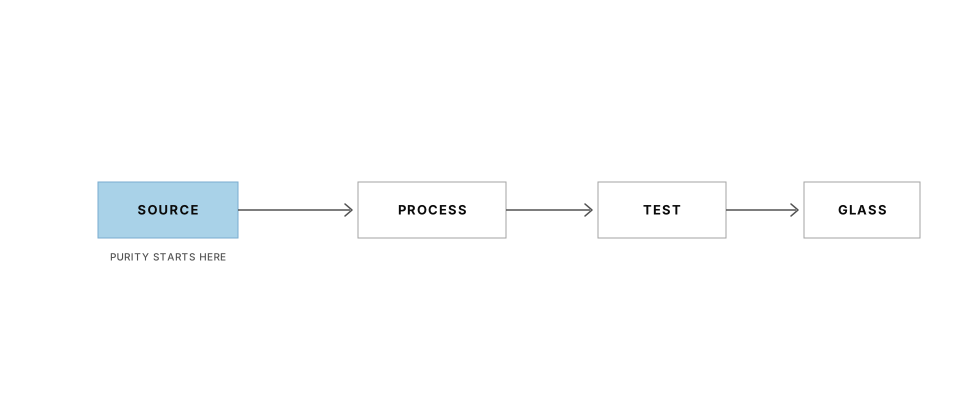
The goal, stated plainly: buy from the right place, buy at the right grade, test the lot you received, publish what you find. In that order. None of those four steps is optional, and none substitutes for the others.
Testing verifies. Sourcing decides. The two are not substitutes for each other.
This statement has not been evaluated by the Food and Drug Administration. This product is not intended to diagnose, treat, cure, or prevent any disease.
Grade, sourcing, and the logic of “just”
The word on the label has always meant subtraction: only what belongs, nothing that does not. That principle applies to additives, dyes, and sweeteners — but it applies equally to contaminants.
Subtraction in formulation is usually discussed in terms of what you leave out deliberately: no artificial sweeteners, no dyes, no fillers. But contaminants are also subtractions — or rather, failures to subtract. Arsenic in a mineral salt is not an ingredient. It is the residue of a sourcing decision that did not prioritize its removal. The formula is supposed to contain only what the label says.
That framing connects grade and sourcing to the same logic that drives every other formulation decision. “Just” is not only about the ingredients you choose to add. It is about the impurities you choose to exclude — starting with where you source.
Sources
- United States Pharmacopeia (USP) — General Chapters <232> Elemental Impurities—Limits and <2232> Elemental Contaminants in Dietary Supplements; USP–NF identity and purity monographs for sodium chloride, potassium chloride, and magnesium compounds. USP–NF, current edition.
- NSF/ANSI 173 — Dietary Supplements. NSF International certification standard for ingredient identity, purity, and potency. NSF International, current edition.
- Clean Label Project — Protein Powder Study (2018, testing by Ellipse Analytics; revisited 2024–2025). Plant-based protein powders averaged measurably higher heavy-metal levels than whey- or egg-based, attributed to soil bioaccumulation; roughly three-quarters of products tested had detectable lead. Cited as an illustration of origin-driven contamination. cleanlabelproject.org (independent testing organization; findings have drawn industry critique).
- FDA — GRAS (Generally Recognized as Safe) database; 21 CFR Part 182 (food-grade mineral salts). U.S. Food & Drug Administration. Food-ingredient purity specifications: Food Chemicals Codex (FCC), USP.
- Peer-reviewed reviews in the Journal of Trace Elements in Medicine and Biology and Food and Chemical Toxicology — documenting source-deposit origin (soil and mineral bioaccumulation) as a primary driver of heavy-metal levels in mineral-derived supplement ingredients.
Purity starts before the label
The science hub maps the evidence behind every formulation decision. Grade and sourcing sit at the beginning of that chain.