Purity & safety · educational
How testing actually works: ICP-MS and the Certificate of Analysis
ICP-MS is the method that can detect heavy metals down to parts per billion. A Certificate of Analysis is the document that records what it found. This article explains both — so you can evaluate any brand’s purity claim, not just ours.
ICP-MS: the method that reads parts per billion
Independent testing organizations — the same groups whose protein powder and supplement studies get cited in the news — report their results in parts per billion. That unit matters: a part per billion is one microgram per liter, or roughly one drop of water in an Olympic swimming pool. To work at that resolution, you need a method that can distinguish individual isotopes at vanishingly small concentrations.
- ICP-MS — inductively coupled plasma mass spectrometry
- The analytical method regulators and accredited independent laboratories use for trace elemental analysis. The U.S. EPA designates it as Method 6020B for determining trace metals in solid and liquid samples. USP General Chapter <2232> cites it as the reference method for elemental contaminants in dietary supplements. When a study says a product contained X micrograms per gram of lead, ICP-MS is almost always how they got that number.
- CoA — Certificate of Analysis
- The document a laboratory issues that records the results of testing a specific batch or lot of a product or ingredient. It is the paper trail that connects a purity claim to an actual measurement made by an actual instrument on an actual production run.
- ppb — parts per billion
- The unit in which ICP-MS results are typically reported for trace elemental work: micrograms per kilogram (μg/kg) for solids, or micrograms per liter (μg/L) for liquids. Some configurations of ICP-MS push sensitivity to parts per trillion (ppt).
ICP-MS is the same class of instrument used to test drinking water, soil, food, pharmaceutical ingredients, and environmental samples. It is not a supplement-industry-specific tool. Its outputs are comparable across labs that follow the same validated method, which is why studies from different organizations can be meaningfully compared — provided they report method, detection limits, and laboratory accreditation.
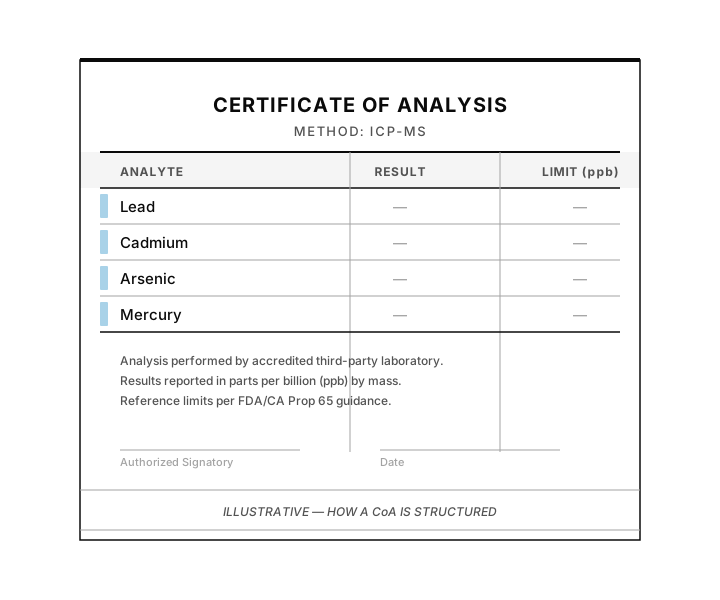
Six columns, six questions
A CoA that is meaningful for heavy metals should contain at minimum six things. Each one answers a question a buyer should be able to ask.
Analyte — what was tested
The element being measured: arsenic (As), cadmium (Cd), lead (Pb), mercury (Hg). All four should be listed. A CoA that tests only one or two metals is not a comprehensive heavy-metals CoA.
Result — what the instrument found
A numeric value in μg/kg or μg/L. “ND” (not detected) is meaningful only if the document also states the detection limit — because ND at a detection limit of 500 μg/kg tells you much less than ND at a detection limit of 5 μg/kg.
Limit — the ceiling the result is compared against
The specification the result is being evaluated against. A CoA showing only results, with no limit column, is less useful than one that shows result, limit, and pass/fail for each analyte. The limit should be traceable to something external — USP <2232>, NSF/ANSI 173, or a regulatory standard — not just a number the brand chose internally.
Method — how the instrument ran
ICP-MS, ideally with a specific method citation (EPA 6020B, USP <2232>). If the method is a colorimetric technique rather than mass spectrometry, the detection limits are typically higher and the result less informative for trace-level work.
Batch / Lot — which production run was tested
The lot or batch code on the CoA should match the code on the product you hold. A CoA that does not correspond to your specific production run is evidence about a different batch, not yours.
Laboratory — who ran the test
The lab should be named and identifiable. Search for it in an ISO/IEC 17025 accreditation database — the ILAC (International Laboratory Accreditation Cooperation) maintains a public directory. An unaccredited lab’s results carry less weight. Independent of the manufacturer is better than in-house.
The distinction that actually matters to a buyer
“We test”
- Most supplement manufacturers of any size conduct some testing.
- Results stay internal — sometimes for competitive reasons, sometimes on legal counsel’s advice.
- You receive the brand’s conclusion, but not the data that produced it.
- Not dishonest, but provides no external verification.
- You have to take someone’s word for it.
“We publish results”
- Batch-level CoAs from an accredited independent lab are published and accessible.
- The lot number is verifiable against what’s on the product packaging.
- The laboratory’s accreditation can be looked up in an external database.
- The result can be compared against the stated limit by anyone.
- The document is either coherent or it is not — no word needed.
The two columns above describe the general distinction a buyer should look for in any brand — they are not a description of our own current practice or results. The first question to ask when evaluating any supplement brand’s purity claims is not “do they test?” It is “can I see the CoA, and does it name an independent accredited lab?” Until there is a mandatory federal standard requiring batch-level disclosure, the only mechanism available to consumers is requesting and reading the document. Setting out that standard here is a way of making the expectation legible for any brand, not a way of advertising results of our own.
To be clear about ourselves: no batch has been produced or tested yet, so we make no test claim and publish no Certificate of Analysis here. Our commitment, once a first batch exists, is the standard described above — batch-level heavy-metals testing by an accredited independent lab, with the CoA published and its lot number matched to the product.
The consumer’s only real lever
The independent testing studies that found heavy metals in supplements used ICP-MS and reported findings with the specificity that method enables. That specificity is what gives their findings weight, and it is what makes a brand’s CoA legible: when a study and a product’s test report use the same method and unit, you can make a direct comparison.
Until a mandatory federal standard requires supplement manufacturers to test for and disclose heavy metal content at the batch level, the only mechanism available to consumers is requesting and reading the CoA. That may seem like asking a lot of someone buying a hydration powder. The alternative — taking purity on faith — is a position the testing record does not support as a default.
This statement has not been evaluated by the Food and Drug Administration. This product is not intended to diagnose, treat, cure, or prevent any disease.
Sources
- U.S. EPA Method 6020B (SW-846) — Inductively Coupled Plasma-Mass Spectrometry for trace metals in solid and liquid samples. United States Environmental Protection Agency.
- USP General Chapter <2232> — Elemental Contaminants in Dietary Supplements. United States Pharmacopeia–National Formulary. Sets limits for the four metals of toxicological concern (As, Cd, Pb, Hg) in finished supplements and references ICP-MS methodology.
- NSF/ANSI 173 — Dietary Supplements. The American National Standard for dietary supplement certification (NSF International); includes contaminant testing requirements and per-daily-dose limits for heavy metals.
Know what you are looking at
The science hub covers the full picture — from what contaminants exist in the supplement industry to what we think the answer looks like.