The problem
Dehydration vs. depletion: two problems people treat as one
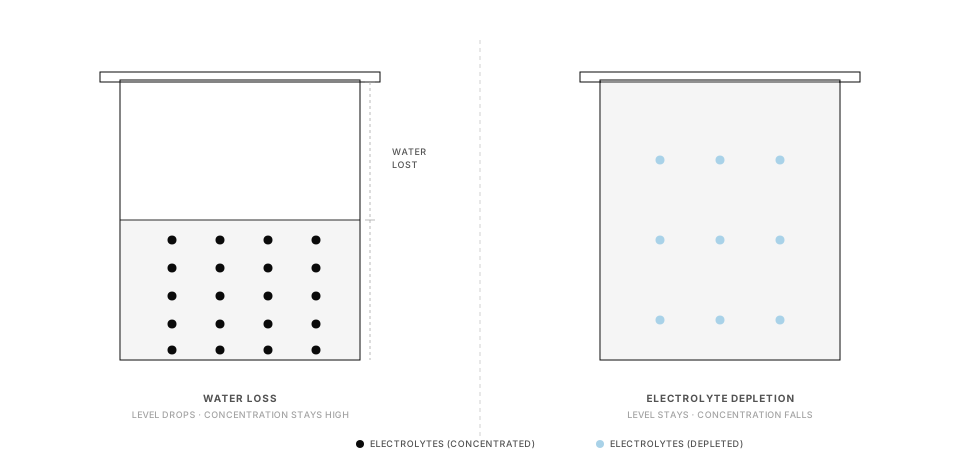
You can lose water without losing meaningful electrolytes. You can lose electrolytes without much net water loss. These are different events, they feel different, and they have different fixes. The reason water alone is sometimes the right answer and sometimes makes things worse is that the two conditions respond to opposite interventions — and most people never learn which one they are facing.
Two words that describe two different problems
Dehydration is a net loss of water relative to solutes. Depletion is a net loss of electrolytes — principally sodium — relative to water. Both can happen at once, but they are not the same event.
- Dehydration
- A state in which total body water has fallen relative to dissolved solutes (electrolytes, proteins, and other particles). Plasma becomes more concentrated — the osmolarity rises. Thirst is the principal signal. The fix is water, or water with electrolytes to restore both what was lost.
- Electrolyte depletion
- A state in which electrolyte concentration — particularly plasma sodium — has fallen relative to total body water. When plasma sodium drops far enough, the result is hyponatremia. The fix is sodium (and other electrolytes), not water alone. Adding plain water to a sodium-depleted system does not restore the sodium; it dilutes it further.
- Plasma osmolarity
- The variable that links both: the concentration of dissolved particles in the blood, normally about 275–295 mOsm/L. Dehydration raises it; electrolyte dilution lowers it. Hydration is the process of keeping it in range.
Most exercise involves both at once, to varying degrees. Sweat is the dominant route of fluid and electrolyte loss during physical activity, and what sweat actually contains determines the ratio of the problem you are trying to correct.
Sweat is hypotonic — but not sodium-free
Sweat is less concentrated than blood — physiologists call it hypotonic relative to plasma. That means losing sweat raises your plasma concentration slightly, even as you lose electrolytes in absolute terms.
Sweat sodium concentration varies considerably from person to person — the range documented in the literature spans roughly 20 to 80 mEq/L, with most people somewhere in the middle. Baker (2017) provides a thorough breakdown. Plasma sodium sits around 140 mEq/L. Because sweat sodium is lower than plasma sodium, the net effect of sweating is a proportionally larger water loss than electrolyte loss — which tends to raise plasma osmolarity slightly, triggering thirst.
This is why the dehydration frame dominates: when you sweat, you are, in a narrow sense, more dehydrated than depleted, and water will help. But it will not fully correct the electrolyte deficit that comes with the water loss. Replacing only the water without replacing any sodium progressively lowers the sodium-to-water ratio in the blood — moving toward hyponatremia.
The magnitude of sodium loss depends on exercise duration, sweat rate, and individual sweat sodium concentration. A two-hour effort at high intensity can produce losses that plain water will not adequately address. A fifteen-minute walk will probably not produce meaningful depletion at all. The question is which problem you are actually facing.
20–80
mEq/L of sodium in sweat — the documented range across individuals (Baker, 2017)
~140
mEq/L of sodium in plasma — sweat is consistently more dilute, hence hypotonic
both
the usual answer — most significant exercise produces water and sodium loss together, in a ratio
The fix depends on which you are facing
Dehydration (water loss)
- Plasma osmolarity rises — blood becomes more concentrated.
- Thirst is pronounced; urine darkens.
- Fix: water, or a balanced electrolyte drink that replaces both water and solutes.
- Plain water is an appropriate response for mild cases.
Electrolyte depletion (sodium loss)
- Plasma osmolarity falls — blood becomes more dilute.
- Thirst may be reduced or absent; nausea, headache, bloating.
- Fix: sodium (and other electrolytes), not water alone.
- Plain water worsens dilution — it adds volume without adding sodium.
When water makes it worse
The most serious version of this confusion is exercise-associated hyponatremia — a condition in which drinking large volumes of plain water during or after prolonged exercise dilutes plasma sodium to a clinically dangerous level.
Hyponatremia is not common in casual exercise, but it is well-documented in endurance events. The Third International Exercise-Associated Hyponatremia Consensus (Hew-Butler et al., 2015) established that the primary cause is excessive hypotonic fluid intake — drinking more plain water than the kidneys can excrete, combined with meaningful sodium loss through sweat. The result is a falling plasma sodium that can, in severe cases, cause cerebral edema and seizure.
The consensus recommendation is thirst-guided drinking: drink when you are thirsty, not on a fixed schedule, and use sodium-containing fluids for events lasting more than an hour. The risk is not drinking water — it is drinking large volumes of plain water while ignoring the sodium deficit that accumulates over long, sweaty effort.
This is why “drink more water” is sometimes exactly wrong. It is right for dehydration. It is wrong for electrolyte depletion with inadequate sodium replacement.
Plasma sodium concentration is the number that determines which problem you have and which intervention helps. You cannot monitor it at home, but you can understand the logic well enough to match the intervention to the situation.
This statement has not been evaluated by the Food and Drug Administration. This product is not intended to diagnose, treat, cure, or prevent any disease.
Most exercise produces both, in a ratio
The two-beaker model is useful for understanding the concepts but misleading if taken too literally. Real sweating does not produce pure water loss or pure electrolyte depletion — it produces both, simultaneously, at a ratio determined by sweat rate, composition, and duration. The question is whether the replacement strategy you use matches the ratio of what was lost.
For most moderate exercise lasting under an hour, plain water is probably adequate. The body has meaningful sodium reserves and the kidneys handle modest imbalances. For longer sessions, higher sweat rates, or individuals with high sweat sodium (the “salty sweater”), sodium replacement becomes meaningful earlier.
Oral rehydration research has converged on a similar answer. The principle of oral rehydration therapy is that a solution carrying both sodium and a small glucose dose is absorbed faster than water alone, because the two are co-transported across the gut wall by the SGLT1 pathway. The Cochrane review of reduced-osmolarity ORS refined the recipe further — a lower-concentration sodium-glucose solution reduced the need for intravenous fluids, stool output, and vomiting compared with the older, more concentrated standard formula. The lesson that carries over to exercise is the same: the right answer is a solution calibrated to what was actually lost, not water by itself.
That is what the formula aims to be: the right ratio of what sweat takes, at a concentration that works with absorption physiology rather than against it. Nothing else in the glass.
This statement has not been evaluated by the Food and Drug Administration. This product is not intended to diagnose, treat, cure, or prevent any disease.
Sources
- Baker LB. Sweating rate and sweat sodium concentration in athletes: a review of methodology and intra/interindividual variability. Sports Medicine 47(Suppl 1):111–128, 2017. doi:10.1007/s40279-017-0691-5 — sweat is hypotonic; sweat sodium ranges roughly 20–80 mEq/L; water and sodium losses differ in proportion.
- Hew-Butler T, Rosner MH, Fowkes-Godek S, et al. Statement of the Third International Exercise-Associated Hyponatremia Consensus Development Conference, Carlsbad, California, 2015. Clinical Journal of Sport Medicine 25(4):303–320, 2015. doi:10.1097/JSM.0000000000000221 — primary cause is excess hypotonic fluid intake; thirst-guided drinking recommended; sodium-containing fluids for prolonged events.
- Hahn S, Kim Y, Garner P. Reduced osmolarity oral rehydration solution for treating dehydration caused by acute diarrhoea in children. Cochrane Database of Systematic Reviews 2002, Issue 1, CD002847. doi:10.1002/14651858.CD002847 — reduced-osmolarity sodium-glucose ORS outperformed standard ORS on intravenous-infusion need, stool output, and vomiting in dehydration from diarrhoea.
Match the fix to the problem
The formula is built around what sweat actually removes — water and sodium together, in a physiological ratio. The science hub maps the full picture.