Mechanism & formula
Citrate, not chloride
Sodium is sodium. What matters is what it is paired with. Sodium citrate and sodium chloride deliver the same cation on a very different anion — and the anion changes the taste, the pH, and the experience of drinking it on an empty stomach.
Two salts, same sodium
A salt is an ionic compound — a positively charged cation paired with a negatively charged anion. In sodium chloride (table salt), sodium is paired with chloride. In sodium citrate, it is paired with the citrate ion, the conjugate base of citric acid. The sodium is identical; the anion is not.
- Sodium chloride (NaCl)
- 39.3% sodium by weight. The reference for “salty” taste. Dissociates in water into Na+ and Cl−. pH-neutral in solution.
- Trisodium citrate dihydrate
- 23.45% sodium by weight. Dissociates into three Na+ and one citrate3− ion. Mildly alkaline in solution (pH typically 7.5–9).
- Conjugate base
- When an acid donates a proton (H+), what remains is its conjugate base. Citric acid (C6H8O7) donates protons to become citrate (C6H5O73−). Citrate in solution buffers the pH upward — away from acid — because it can accept protons.
The anion is the part most people never think about. It is not flavor-neutral and it is not pH-neutral. Chloride is small and highly mobile; citrate is large and carries a triple negative charge. Those differences cascade into taste, buffering behavior, and what the solution does to pH.
Why citrate doesn’t taste like table salt
The perception of saltiness is not just about sodium. The anion matters.
Salty taste is driven by the sodium cation, but the anion paired with it modulates how salty a solution reads. Taste research describes more than one salt-sensing process: one responds to sodium largely independent of the anion, and a second is anion-dependent and sensitive to the size of that anion. The net effect, measured in human and animal studies, is that small anions like chloride support a stronger salty signal than large anions do.
Citrate is a large, triple-charged anion. At an equal sodium dose, sodium salts of large anions — citrate, gluconate — consistently taste less salty than sodium chloride. The result is a perceptibly milder taste, less sharp and less briny. This is not a marketing claim about smoothness; it is a repeatable consequence of which anion carries the sodium.
The practical implication: a drink dosed to deliver, say, 500 mg of sodium from citrate will taste less salty than the same 500 mg delivered from chloride. If drinkability determines whether someone actually hydrates, the choice of anion is not cosmetic.
The anion is the part most people never think about. In sodium chloride it is small; in sodium citrate it is large and triple-charged. Same sodium, different anion — and that difference changes what the tongue registers.
Citrate buffers; citric acid bites
Citric acid and citrate are not the same molecule. They are conjugate pairs — one the acid, one the base.
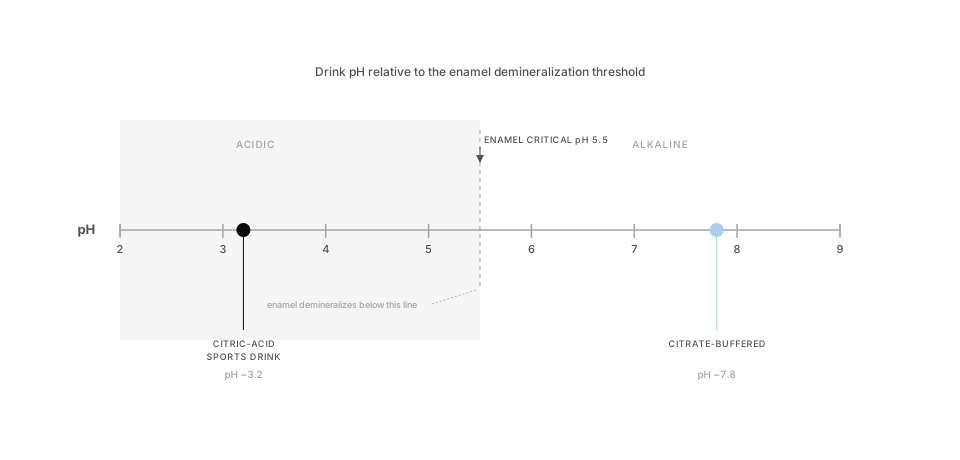
Citric acid (C6H8O7) is a triprotic acid: it has three acidic protons it can donate. In solution, it lowers pH significantly — citric-acid-flavored sports drinks typically run between pH 2.5 and 4. That acid is what gives them their characteristic sharp, sour bite, and it is what puts them on the wrong side of the enamel line.
Trisodium citrate is the fully deprotonated form — citric acid has already donated all three protons, replaced by three sodium ions. In solution, it is the conjugate base of a weak acid, which means it buffers the pH mildly alkaline rather than acidic. A solution of trisodium citrate in water will typically read pH 7.5–9, depending on concentration.
When you add trisodium citrate to water, you are not adding citric acid. You are adding the base that remains after citric acid has given up its protons. The two are chemically related — one is derived from the other — but they behave in solution as chemical opposites with respect to pH.
The enamel line at pH 5.5
Tooth enamel is hydroxyapatite — a calcium-phosphate mineral that dissolves in acid. The rate of dissolution increases sharply below a critical pH threshold.
The critical pH for enamel demineralization is commonly cited as about 5.5. It is not a single fixed number — it varies inversely with the calcium and phosphate concentration of the surrounding fluid — but ~5.5 is the conventional value for normal saliva. Above it, enamel is stable under ordinary conditions; below it, acid begins to dissolve the mineral matrix of the tooth. Prolonged or repeated exposure to acidic drinks — including many sports drinks, sodas, and flavored waters that use citric acid as a flavoring — is a recognized contributor to dental erosion.
A drink buffered by trisodium citrate, rather than acidified by citric acid, sits above that line. The pH is mildly alkaline — typically above 7 — which places it on the safe side of the enamel threshold. This is not a claim about preventing dental disease. It is a consequence of the chemistry that was chosen for the formula.
5.5
critical pH below which enamel begins to demineralize
~7.5
approximate pH of trisodium citrate in solution
2.5–4
typical pH range of citric-acid sports drinks
Chloride versus citrate
The two most common sodium salts used in electrolyte products, compared.
Sodium chloride
- 39.3% sodium by weight.
- Small, highly mobile anion.
- Sharp, briny, strongly salty taste.
- pH-neutral in solution (~7).
- Widely used; the reference “salty” compound.
Trisodium citrate
- 23.45% sodium by weight — requires more compound per gram of sodium.
- Large, triple-negative anion; moves slowly through taste receptor spaces.
- Mild, less-briny taste at equivalent sodium doses.
- Mildly alkaline in solution (~7.5–9).
- Buffers the drink above the enamel critical pH of 5.5.
What we are not claiming
A mildly alkaline drink does not alkalize your blood. That is worth stating plainly.
Blood pH is regulated within a tight range — approximately 7.35–7.45 — by the lungs and kidneys working constantly. This is not a passive system that a drink can override. The idea that an alkaline beverage “alkalizes the body” is not how human physiology works. The buffering system is powerful enough that drinking a mildly alkaline solution produces a detectable change in urine pH, not blood pH.
The claim about citrate is narrow and grounded: the drink sits above the enamel critical pH because of the chemistry of the anion chosen, and it tastes milder than a chloride-based drink at the same sodium dose because of the anion’s size. Those are consequences of chemistry, not clinical claims.
We use trisodium citrate because it is the right salt for this formula — better taste profile, mildly alkaline rather than erosive, and it delivers sodium without the sharp brine of table salt. Not because of claims that extend beyond what chemistry actually supports.
This statement has not been evaluated by the Food and Drug Administration. This product is not intended to diagnose, treat, cure, or prevent any disease.
Sources
- Roebber JK, Roper SD, Chaudhari N. The role of the anion in salt (NaCl) detection by mouse taste buds. Journal of Neuroscience 39(32):6224–6232, 2019 — amiloride-insensitive salt transduction depends on the anion; smaller anions support a stronger salty signal.
- Institute of Medicine. Taste and flavor roles of sodium in foods. In: Strategies to Reduce Sodium Intake in the United States. Washington, DC: The National Academies Press, 2010 — saltiness rises with the sodium cation but the anion modulates intensity; larger anions (e.g., gluconate) taste less salty than chloride at equal sodium.
- Dawes C. What is the critical pH and why does a tooth dissolve in acid? Journal of the Canadian Dental Association 69(11):722–724, 2003 — the critical pH is not a fixed value; it varies inversely with calcium and phosphate concentration, with ~5.5 the conventional figure for normal saliva.
- Standard acid-base chemistry — citrate as the conjugate base of citric acid (pKa values ~3.1, 4.8, 6.4 for citric acid; trisodium citrate in solution typically pH 7.5–9).
The right salt for the formula
The choice of anion is a chemistry decision, not a marketing one. The science hub explains the rest.