Use cases
Dosing for endurance: turning losses into a plan
Two pieces of advice dominate endurance hydration: replace what you lose, and don’t overdrink. They sound like contradictions. They are not. The synthesis is individualized, thirst-guided replacement that prioritizes sodium concentration over raw fluid volume.
Two rules, one sport
Endurance sports have produced two hydration rules backed by good evidence. On their face, they pull against each other.
The first rule comes from exercise physiology: sweat losses during hard, long efforts are real and significant. A recreational marathoner in warm weather can lose 1.5 to 2.5 liters of fluid per hour and somewhere between 700 and 2,000 mg of sodium per hour — depending on body size, intensity, heat, and genetics. Left unaddressed, that deficit accumulates into measurable performance impairment and, eventually, clinical dehydration.
The second rule comes from sports medicine: drinking too much plain water during exercise is dangerous. Exercise-associated hyponatremia — a life-threatening fall in blood sodium — is almost always caused by drinking more fluid than the body is losing, diluting the sodium that remains. The problem is not dehydration. It is overhydration, combined with continued sodium loss into sweat.
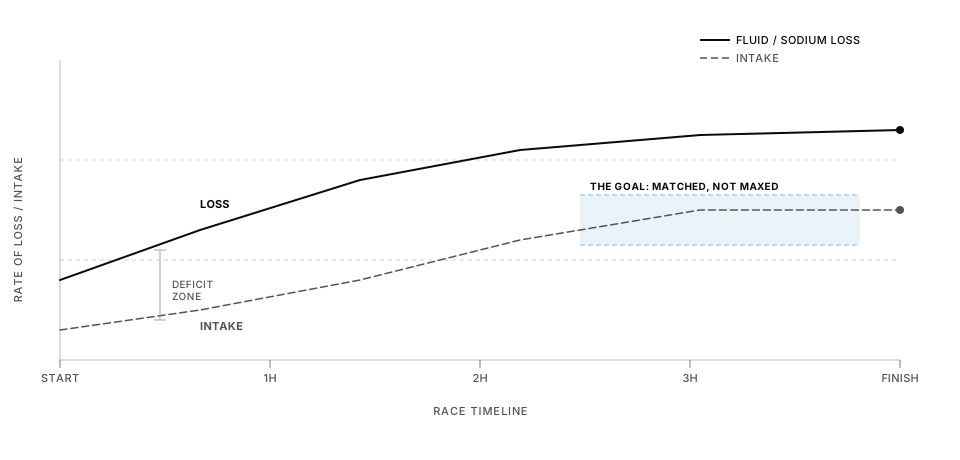
Both statements are true. The apparent contradiction dissolves once you see what they are each responding to: the first addresses inadequate sodium replacement; the second addresses excessive fluid intake without sodium. The resolution is to do both at once — replace the sodium, match the fluid volume to losses rather than exceeding them, and let thirst guide the rate.
700–2,000 mg/h
reported sweat sodium loss range across athletes — a nearly three-fold spread at the same effort level
~1%
body mass loss where some studies begin to detect performance effects — though thirst generally precedes this
>60–90 min
effort duration above which sodium replacement generally matters most — shorter sessions rarely accumulate meaningful deficit
The heavy sweater who replaces only water
Some athletes lose sodium at rates that generic guidance simply does not account for. At the high end, sweat sodium can exceed 1,800 mg per liter of fluid lost.
A salty sweater finishing a four-hour race in moderate heat might lose 7 to 10 liters of fluid and upward of 10,000 mg of sodium. If that athlete drinks plain water or a low-sodium drink to quench thirst, they are replacing the volume without replacing the solute. Blood sodium falls. In mild cases: muscle cramps, fatigue, mental fog. In severe cases: hyponatremia — the same dilution problem that afflicts overdrinking athletes, just arriving via a different route.
The fix is not less fluid. It is more sodium in the fluid. A high-sodium athlete needs a drink with meaningful sodium content — not a trace mineral formulation, not plain water, not a standard low-sodium sports drink. The sodium concentration in the drink needs to approximate the sodium concentration in their sweat.
This is why sweat sodium variability matters so much in practice. A 40 mmol/L sweater and a 90 mmol/L sweater can be doing exactly the same workout and need entirely different electrolyte concentrations. See the salty sweater for the genetics and recognition patterns.
Hyponatremia from sodium under-replacement is clinically similar to hyponatremia from overdrinking. The mechanism is the same — blood sodium falls below 135 mmol/L — but the intake pattern differs: one athlete drank too much, the other lost too much. Both end at the same place.
Overdrinking plain water
The “drink before you’re thirsty” era produced a specific pathology that the sports medicine community has spent twenty years unwinding.
Through much of the 1990s and early 2000s, athletes were advised to drink on a schedule — a fixed volume per hour, regardless of thirst, often exceeding actual sweat rate. The intent was to stay ahead of dehydration. The effect, particularly in longer events, was sometimes the reverse: athletes drank more than they sweated, plasma volume expanded, and blood sodium diluted.
Exercise-associated hyponatremia is now well described in the literature: it is almost exclusively seen in events longer than four hours, in athletes — often slower athletes — who have time to consume large volumes of fluid. The profile is not the lean, fast competitor who finishes in two hours with a modest fluid deficit. It is the athlete who walks a marathon over six hours, sipping a cup of plain water at every mile marker, finishes with a net fluid gain, and presents with nausea and confusion.
The Third International Exercise-Associated Hyponatremia Consensus Statement (Hew-Butler et al., 2015) arrived at a clear recommendation after reviewing the evidence: drink to thirst. Thirst is a regulated physiological signal calibrated to plasma osmolality. When it is functioning normally, it prevents both chronic under-drinking and dangerous over-drinking. The goal is not to suppress thirst by pre-loading fluid; it is to respond to thirst with an appropriately concentrated drink. See hyponatremia for the full mechanism.
Concentration first, volume second
Both failure modes share a corrective: the sodium concentration in what you drink matters more than the total volume.
An electrolyte strategy built around concentration-first means: put enough sodium in the glass that each mouthful, however large or small, replaces sodium proportionally with fluid. Then drink to thirst. The fluid volume self-regulates toward a reasonable match with losses; the sodium concentration ensures that replacement fluid does not dilute the blood it enters.
Matching intake to estimated losses is the goal, not maximizing intake. This does not require laboratory precision. It requires a reasonable estimate of your sweat rate, an estimate of your sweat sodium concentration (easier to approximate than to measure exactly), and a drink formulated to a concentration that serves your end of the range — not a median that fits no one in particular.
For many athletes, this resolves to a straightforward habit: use a moderately high-sodium electrolyte drink for efforts over 60 to 90 minutes, drink when thirsty, and calibrate over several sessions using weight changes as a rough proxy for fluid balance. Losing a small amount of body mass (0.5–2%) across a long effort is normal and not necessarily problematic; gaining mass during an effort is a sign of over-drinking. See sweat-rate math for the protocol.
A practical table for different effort lengths
These are general starting-point ranges derived from the peer-reviewed sweat-loss literature — not individualized prescriptions. Individual variation is wide enough that they must be calibrated to personal experience.
| Effort length | Conditions | Sodium consideration |
|---|---|---|
| <45 min | Any | Water usually sufficient; losses are modest and recoverable at the next meal |
| 45–90 min | Moderate conditions | Optional for most; beneficial for salty sweaters or high heat even at this duration |
| 90 min–3 h | Cool to warm | Sodium replacement generally beneficial; starting-point 500–1,000 mg/h depending on sweat rate and concentration |
| >3 h | Any; especially warm or hot | Sodium essential; risk of hyponatremia from overdrinking rises; prioritize sodium concentration over raw fluid volume |
| Any, heat & salty sweater | High sweat sodium confirmed or suspected | Needs above-median sodium concentration regardless of effort length; generic guidance will under-serve |
This statement has not been evaluated by the Food and Drug Administration. This product is not intended to diagnose, treat, cure, or prevent any disease. The table above reflects general starting-point guidance drawn from peer-reviewed sweat-loss literature and is not an individualized medical prescription.
Three circumstances that raise the stakes
Electrolyte strategy is not equally important across all conditions. Three circumstances substantially raise both the benefit of getting it right and the cost of getting it wrong.
Long duration: over 60–90 minutes
Below roughly 60 minutes, deficits rarely accumulate to performance-relevant levels and are easily recovered at the next meal. Above 90 minutes, sodium loss becomes significant even in average sweaters. Above three hours, the risk of overdrinking-induced hyponatremia is also meaningful, making sodium concentration in the drink critical on both sides of the equation.
Heat: warm or hot conditions
Heat drives sweat rate up — the body’s thermoregulatory response demands more fluid for cooling. More sweating means more sodium loss per unit time, and often more ad-hoc drinking (increasing overdrinking risk). An athlete who manages hydration adequately in 60°F weather may be substantially under-replaced in 85°F heat.
Salty sweaters: high sweat sodium concentration
Sweat sodium concentration spans a wide range between individuals — commonly cited from roughly 20 to 90 mmol/L, an extreme spread approaching nine-fold at the tails, with most athletes clustering across a four- to five-fold range. At the high end — depending on the threshold used, on the order of one in ten to one in five athletes — sodium losses per liter of sweat are large enough that a moderately concentrated electrolyte drink still leaves a deficit. These athletes often notice characteristic signs: white residue on skin or kit, salt-stained clothing, disproportionate muscle cramping. They need a drink matched to their actual sweat concentration, not a median formulation. See the salty sweater.
Sources
- Hew-Butler T, et al. Third International Exercise-Associated Hyponatremia Consensus Statement. Clinical Journal of Sport Medicine 25(4):303–320, 2015 — drink to thirst; avoid overdrinking. The consensus review that settled the active guidance away from scheduled drinking.
- Sawka MN, et al. American College of Sports Medicine Position Stand: Exercise and Fluid Replacement. Medicine & Science in Sports & Exercise 39(2):377–390, 2007 — sweat rate ranges, fluid replacement recommendations, and performance-dehydration thresholds.
- Baker LB. Sweating rate and sweat sodium concentration in athletes: a review of methodology and intra/interindividual variability. Sports Medicine 47(Suppl 1):111–128, 2017 — sweat sodium loss ranges and the magnitude of individual variation.
Replace what you lose. No more, no less.
The science hub maps the full picture. Every number in this article appears in the formulation decisions behind the product.